


Diptera.info :: Identification queries :: Diptera (adults)
 Tephritid of today
|
|
| Sundew |
Posted on 30-05-2010 19:12
|
 Member Location: Berlin and Baden-Württemberg, Germany Posts: 3939 Joined: 28.07.07 |
Hi, This afternoon I met this small Tephritid. The only species of my collection that bears a certain similarity as to wing pattern is Tephritis nigricauda, but I just want to make sure if I'm halfway right... Many thanks, Sundew Sundew attached the following image: 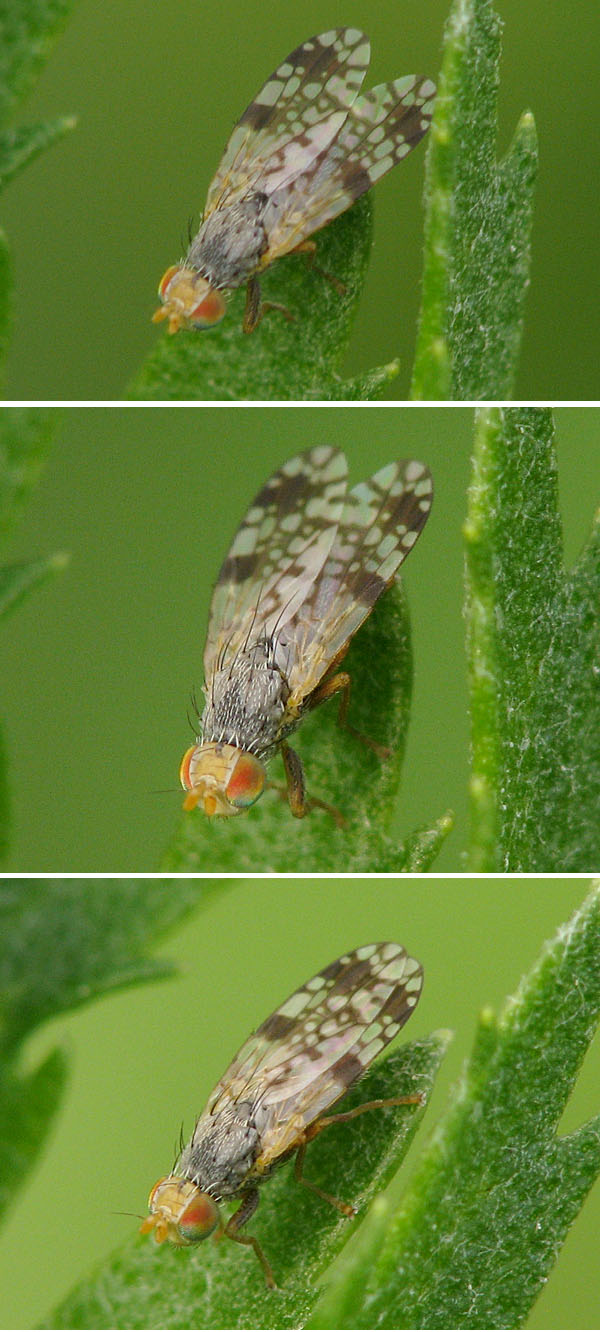 [149.45Kb] |
|
|
|
| Nosferatumyia |
Posted on 30-05-2010 19:32
|
 Member Location: Posts: 3575 Joined: 28.12.07 |
yes. all that we could tell today: sp. cf. tanaceti of the nigricauda group. The obscuriest place in Tephritis. I have 8 boxes, from the whole Palaearctic Region, but see no way to sort them. Even DNA does not help, for the differences must be lesser than the molecular clock show. Val |
|
|
|
| Sundew |
Posted on 30-05-2010 20:37
|
|
Member Location: Berlin and Baden-Württemberg, Germany Posts: 3939 Joined: 28.07.07 |
Well, it sat on Tanacetum vulgare, so tanaceti sounds fine! But a differentiation as to food plants is obviously impossible, otherwise it should be easy to solve the group problems. If even DNA grouping fails, why not adopt a wider species concept in this case as T. nigricauda s. l.? I find it unsatisfying to search for such minute differences that cannot be checked in the field or at least under the microscope. And it is difficult to make the students believe in such elaborated species concepts that can hardly understood by "normal" nature lovers that want to protect biodiversity. Thanks for help! Sundew |
|
|
|
| Nosferatumyia |
Posted on 31-05-2010 10:14
|
|
Member Location: Posts: 3575 Joined: 28.12.07 |
The problem is larger and closer than it superficially looks through the back view mirror. Speciation in the fruit flies strongly depends on the host plants, and in many cases specialization leads to a very fast parapatric speciation. The nigricauda s.l. group is especially widespread in Central Asia, Mongolia and China, where it explores a wide range of Artemisia, Tanacetum, Achillea and allied genera, which enumarates probably one hundred plant species or more! Less than 0,1% of known specimens have been reared from host plants, some 10 species names (nominal species) are included in the group, and I feel like the tailor from the old joke about a very fat lady: "150-150-150. Ma'me, where d'ya like to have the waist?" The fast speciation vs. slow molecular clock is the universal problem of Tephritidae we ran into when barcoding fruit flies of economic importance. So far, no good solution. Edited by Nosferatumyia on 31-05-2010 10:16 Val |
|
|
|
| Nosferatumyia |
Posted on 31-05-2010 10:20
|
|
Member Location: Posts: 3575 Joined: 28.12.07 |
I'd appreciate if you could collect some flies into absolute alcohole and keep them in a fridge to pass them after a while to John Smit to Leiden. Hering described his tanaceti from your area (Brandenburg in its current sense), so it is exactly what he considered "tanaceti". You can safely change the name to Tephritis tanaceti and ask Paul to include it into the gallery. Val |
|
|
|
| Jump to Forum: |