


Diptera.info :: Identification queries :: Diptera (adults)
 Tipulid(?) from Maynmar
|
|
| Nikita Vikhrev |
Posted on 29-11-2009 14:23
|
 Member Location: Moscow, Russia Posts: 9561 Joined: 24.05.05 |
Body about 15mm, Myanmar, stream among secondary vegetation, 900m asl, 29 Nov
Nikita Vikhrev attached the following image:  [131.81Kb] Nikita Vikhrev - Zool Museum of Moscow University |
|
|
|
| Nikita Vikhrev |
Posted on 29-11-2009 14:29
|
|
Member Location: Moscow, Russia Posts: 9561 Joined: 24.05.05 |
Same female ovipositing in the stream silt
Nikita Vikhrev attached the following image:  [131.76Kb] Nikita Vikhrev - Zool Museum of Moscow University |
|
|
|
| Dmitry Gavryushin |
Posted on 29-11-2009 20:43
|
 Member Location: Moscow region, Russia Posts: 3348 Joined: 17.10.05 |
Nice critter, probably Hexatoma sp. |
|
|
|
| Cesa |
Posted on 29-11-2009 21:03
|
 Member Location: Turkey Posts: 1276 Joined: 13.10.09 |
I have a closely related species (attached) from Chiang Mai. Chen Young said that it is a Hexatoma (Eriocera) sp. This identification seems to me very general, and I need a specific ID. Greetings Muhabbet Cesa attached the following image: 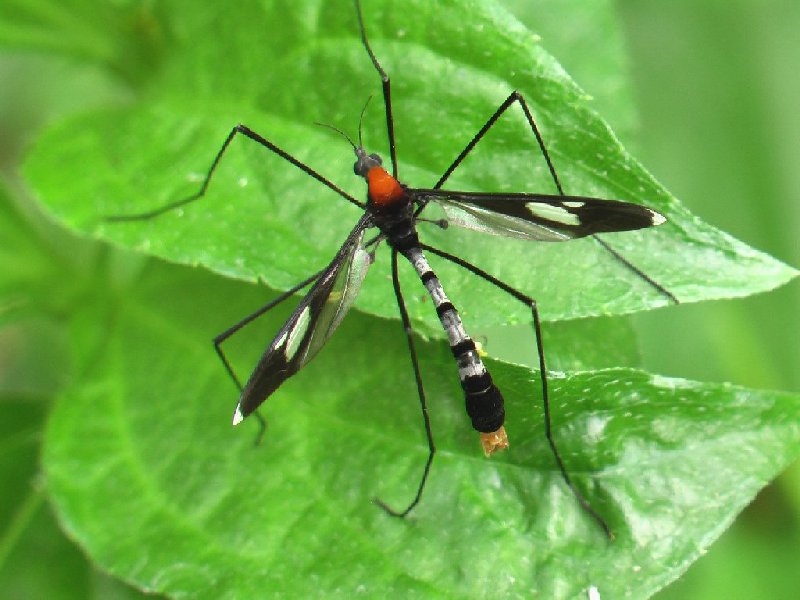 [76.35Kb] Edited by Cesa on 29-11-2009 22:23 |
 |
|
| Dmitry Gavryushin |
Posted on 03-12-2009 00:16
|
|
Member Location: Moscow region, Russia Posts: 3348 Joined: 17.10.05 |
I think the closest match (for the Burmese female) is Hexatoma (Eriocera) nepalensis (Westwood, 1836), cf. Westwood (Insectorum nonnullorum exoticorum (ex ordine Dipterorum) descriptiones. - Ann. Soc. Ent. Fr. [1835] (1) 4: p. 681), as Caloptera nepalensis: 'Nigra; abdomine plumbeo cincto; alis nigricantibus, basi flavis, fasciaque incompleta centrali, transversa alba, ornatis' and Walker (List of the specimens of dipterous insects in the collection of the British Museum. part 1, 1848, p. 79), as Pterocosmus velutinus: 'Nigra, abdomine fasciis nonnullis cinereis, fem. apice fulvo, alis nigro-fuscis basi flavis, fusco unimaculatis'.
While others can't climb, using infinite pains, I, gravity turning to jest, Ascend, with all ease, perpendicular planes, Rough or smooth, just as pleases me best. |
|
|
|
| Stephen R |
Posted on 03-12-2009 10:37
|
 Member Location: Clitheroe Lancashire UK Posts: 2396 Joined: 12.06.09 |
But neither description mentions the white tips to the wings - maybe because the whole genus has them, so they are not distinctive?
Edited by Stephen R on 03-12-2009 10:39 |
|
|
|
| Nikita Vikhrev |
Posted on 03-12-2009 13:24
|
|
Member Location: Moscow, Russia Posts: 9561 Joined: 24.05.05 |
Thank you!
Nikita Vikhrev - Zool Museum of Moscow University |
|
|
|
| Dmitry Gavryushin |
Posted on 04-12-2009 01:40
|
|
Member Location: Moscow region, Russia Posts: 3348 Joined: 17.10.05 |
There are dozens of Hexatoma (Eriocera) described from the region by Edwards, Walker, Brunetti and earlier authors, some have white wing tips, but I'm afraid it's too difficult to come to a conclusion from pictures only. Here's descriptions of two more species by Brunetti, they seem to be appropriate enough, too. Hexatoma (Eriocera) graveleyi Brunetti, 1918 (Records of the Indian Museum, XV, p. 337) Head blackish-grey with short bushy hairs ; proboscis shining black, labella dull yellowish at base ; palpi and antennae black.Thorax normally velvet black, including scutellum, metanotum and pleurae, the latter a little duller. Often ferruginous red from anterior margin of dorsum for a considerable distance or even the whole dorsum up to the scutellum, behind which the red is duller and less conspicuous. In some specimens with an all black thorax there is a trace of red sometimes visible if viewed from a low angle in front. Abdomen velvet black ; basal half of 2nd, 3rd, 4th and 5th segments and to a less extent the 6th and 7th segments with a shining steel band which is whitish on its hinder part. Genitalia in male shining black, approximately normal ; 1st joint of claspers with short grey hairs, 2nd pointed and curved ; a small triangular hairy-tipped ventral style, and a small curved emarginate dorsal plate. In the female basal half of ovipositor bright orange, the remainder shining dark brown. Legs black or very dark brown, base of femora sometimes brownish. Wings dark blackish-brown, with a slight violet tinge ; both axillary cells distinctly paler. A rather large white spot just beyond the middle lying over both basal cells, and a small one in the marginal cell just above the origin of the 3rd vein. Extreme tip of wing with a small white spot extending over the tips of both submarginal cells and the 1st posterior cell. Marginal cross vein distinctly beyond fork of 2nd vein. Five posterior cells. Halteres black. Hexatoma (Eriocera) plumbicincta Brunetti, 1911 (in Fauna of British India, Diptera Nematocera, 1912, pp.541-542) [male] Head : frons and back of head deep velvet-black, with a little black pubescence ; frons with a cone-like projection above each antenna ; eyes black, bare. First joint of scape long, cylindrical, black; 2nd very short, globular, yellowish; flagellum yellowish, with short black hairs, of five very elongated joints of diminishing length, the last one black. Palpi black, pubescent, 2nd joint the widest, 1st and 4th the longest. Thorax deep velvet-black, with short black pubescence ; a slight dark reddish tinge above the neck. Scutellum deep black. Dorsum of metanotum bright reddish orange, bare. Abdomen deep velvet-black ; on the 2nd, 3rd, 4th, and 5th segments a broad shining lead-coloured band extending round the whole segment and covering it with the exception of a posterior marginal band of a widtli of one-fifth of the segment ; 6th segment wholly deep black ; 7th, basal half occupied by a similar leaden band, apical half black ; seen from behind, there is a silver sheen on the sides of the segments. Genitalia conspicuous, bright orange-red, protected below by a blackish plate. Whole abdomen nearly bare. Legs : coxae black, pubescent ; femora and tibiae orange-yellow (the latter rather darker), both with black tips; tarsi dark brown ; all the legs minutely pubescent. Wings brown, darker in the centre ; costal border to just beyond the 1st longitudinal vein distinctlv orange-yellow, the colour ending at tip of the auxiliary vein; wing grey from just in front of the 6th vein to posterior margin ; a good-sized white spot (approximately oval) placed obliquely across the basal cells, towards the distal ends, but quite clear of the discal cell ; a smaller circular white spot just above, and a little in front of, the larger one. situated just beyond the middle of the marginal cell, and a white oval spot at apex of wing, just covering the tips of the two marginal cells. Five posterior cells. Halteres black. Edited by Dmitry Gavryushin on 04-12-2009 01:42 |
|
|
|
| pjotr oosterbroek |
Posted on 24-05-2012 15:28
|
|
Member Location: Amsterdam Posts: 88 Joined: 05.10.05 |
Dear Nikita, Very nice picture of Hexatoma (Eriocera) gravelyi on Diptera.info I checked all available literature and it is almost certain that this gravelyi. See http://nlbif.eti.uva.nl/ccw/ for more details on this species. This website now also includes illustrations at the species level (for example search: Belgium, Ctenophora, habitus). To build this out further, I would like to ask permission to include your photo at this website (if yes, please reply to p.oosterbroek@chello.nl). Thanks in advance. Pjotr |
|
|
|
| Jump to Forum: |