

Diptera.info :: Identification queries :: Other insects, spiders, etc.
 small braconid wasp (continued)
|
|
| Sundew |
Posted on 20-01-2008 00:21
|
 Member Location: Berlin and Baden-Württemberg, Germany Posts: 3939 Joined: 28.07.07 |
Hello, Though ichneumonid wasps are very difficult and my photos are not the best ones, I would like to post this small female that is ovipositing in the floral heads of Tanacetum vulgare (Asteraceae). Can you possibly tell from the plant preference which genus it belongs to? Seen on the Baltic Island of Usedom in August. Many thanks, Sundew Sundew attached the following image: 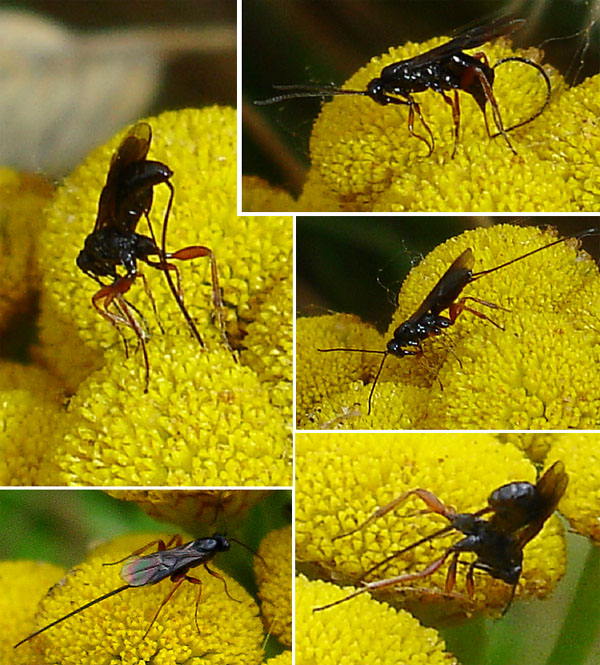 [154.44Kb] Edited by Sundew on 20-01-2008 23:27 |
|
|
|
| Christian Schmid-Egger |
Posted on 20-01-2008 09:38
|
|
Member Location: Germany, Berlin Posts: 233 Joined: 05.08.05 |
It would be impossible to say anything from the plant preference, because the wasp is attacking any insect larva inside the plant. In Asteraceae, often you will find Thevritidae (Diptera) or some Microlepidoptera. Regards, Christian |
 |
|
| cthirion |
Posted on 20-01-2008 19:15
|
|
Member Location: Awirs (Flémalle) Belgique Posts: 901 Joined: 13.08.04 |
Braconidae ! !
cthirion |
|
|
|
| Xespok |
Posted on 20-01-2008 20:05
|
 Member Location: Debrecen, Hungary Posts: 5551 Joined: 02.03.05 |
The diptera family you mean, is Tephritidae.
Gabor Keresztes Japan Wildlife Gallery Carpathian Basin Wildlife Gallery |
|
|
|
| proctoss |
Posted on 20-01-2008 21:51
|
 Member Location: Moscow, Russia Posts: 191 Joined: 12.08.06 |
Yes, Braconidae |
|
|
|
| Sundew |
Posted on 20-01-2008 23:24
|
|
Member Location: Berlin and Baden-Württemberg, Germany Posts: 3939 Joined: 28.07.07 |
Another considerable gain of knowledge. Small ichneumonids are, in fact, braconids, and they parasitize only animals, not plants. And I thought I had possibly detected the source of the funny Tanacetum galls! (The pic, however, was taken at a very distant locality from the pics above, in Brandenburg.) I have often seen larvae in the bottom of the floral heads of thistles etc., but they never caused conspicuous deformations. In the case shown, however, the primordia of single flowers grew into bizarre, sterile galls. Is anybody among us who knows the originator, braconids being innocent? Cordially, Sundew Sundew attached the following image: 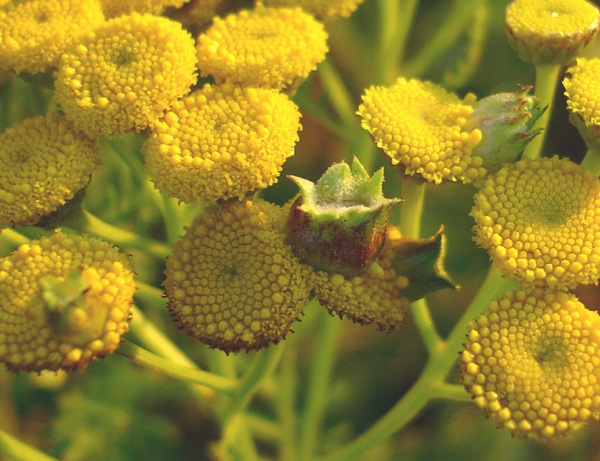 [153.54Kb] Edited by Sundew on 20-01-2008 23:26 |
|
|
|
| cosmln |
Posted on 21-01-2008 00:00
|
 Member Location: Romania Posts: 956 Joined: 18.03.07 |
about galls, i will say that belongs to an cecidomiid Rhopalomyia tanaceticola (Karsch) cosmln |
|
|
|
| Sundew |
Posted on 21-01-2008 00:27
|
|
Member Location: Berlin and Baden-Württemberg, Germany Posts: 3939 Joined: 28.07.07 |
CosmIn, you are a true genius! I googled Rhopalomyia tanaceticola and found several gall pics absolutely identical to mine. Unfortunately, there is no pic of the gall midge itself. I saw you put another gall photo in the gallery, so would it be of use to add the Rhopalomyia tanaceticola galls, too? They seem to be very typical. Anyhow, many thanks for the quick ID! Sundew |
|
|
|
| cosmln |
Posted on 21-01-2008 13:22
|
|
Member Location: Romania Posts: 956 Joined: 18.03.07 |
Sundew wrote: CosmIn, you are a true genius! I googled Rhopalomyia tanaceticola and found several gall pics absolutely identical to mine. Unfortunately, there is no pic of the gall midge itself. I saw you put another gall photo in the gallery, so would it be of use to add the Rhopalomyia tanaceticola galls, too? They seem to be very typical. Anyhow, many thanks for the quick ID! Sundew hihihi, i'm not a genius. just using the books i have. on this address (at page 16) you will find some more exact galls. http://www.mda.state.mn.us/news/publications/pestsplants/badplants/tansybiocontrol2006report.pdf about adding this to the gallery i will say YES, about photo of midge... collect them and wait  i will do that this year... i'm just curios i'm just interested in them... not a specialist at all... and when i have ocasion i make some photo hoping that i can put a name there. welcome and happy that i can help with something, cosmln |
|
|
|
| Jump to Forum: |