


Diptera.info :: Identification queries :: Diptera (adults)
 Cluster around heads of forest hikers
|
|
| gfinlay |
Posted on 20-07-2013 21:08
|
|
Member Location: Posts: 5 Joined: 16.07.13 |
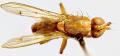
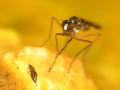
Swarm of dozens of these small flies, each about 0.5 cm in length, around heads of hikers in hardwood forest July 2013 in central New Jersey. This specimen appears to have an external parasite, orange-red in color, resembling a microscopic tick, on the ventral side of abdomen.
gfinlay attached the following image: 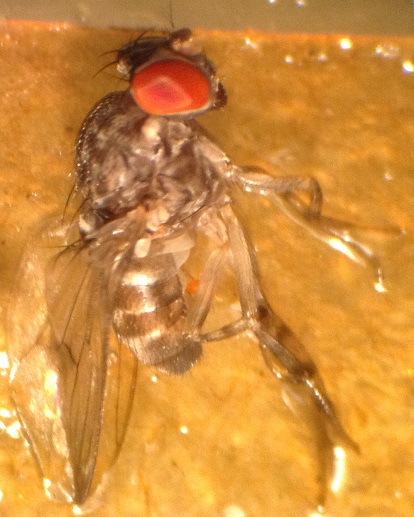 [84.83Kb] Edited by gfinlay on 20-07-2013 21:15 |
|
|
|
| John Carr |
Posted on 20-07-2013 21:29
|
 Super Administrator Location: Colorado, USA Posts: 10652 Joined: 22.10.10 |
Probably Drosophilidae. The red spot should be a mite. See here for a mite on a Drosophila: http://www.dipter...d_id=52207. |
 |
|
| gfinlay |
Posted on 20-07-2013 21:52
|
|
Member Location: Posts: 5 Joined: 16.07.13 |
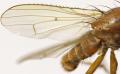
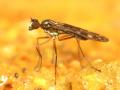
Thanks John. I see Drosophilidae is a large family, including fruit flies. I wonder if there is an online reference I can use to identify down to family or even species? The theory about the mite seems plausible. The live specimen under the stereo microscope does appear similar to mites I have observed on bees. Is the white projection near the root of the wing what I see referred to as an "anal cell"? See new close up image attached. gfinlay attached the following image: 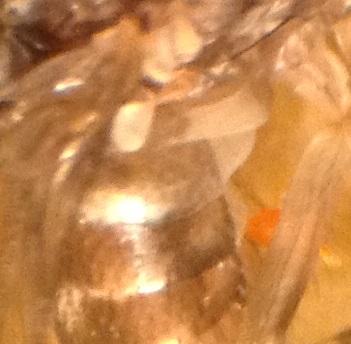 [43.01Kb] |
|
|
|
| John Carr |
Posted on 20-07-2013 23:10
|
|
Super Administrator Location: Colorado, USA Posts: 10652 Joined: 22.10.10 |
The white projection is the halter. Few people know how to identify American Drosophilidae. I don't, except for three distinctive species groups, and this isn't one of them. Black projection on front of wing = Mycodrosophila, small brown spots on thorax = Drosophila repleta group, and "sex comb" on male front tibia = Sophophora. |
|
|
|
| Jan Willem |
Posted on 21-07-2013 12:22
|
 Member Location: Waalwijk, The Netherlands Posts: 2170 Joined: 24.07.04 |
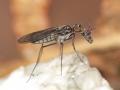
Looks like a Phortica spec. [Drosophlidae]. The flies of this genus have been recorded as a nuisance, trying to enter the eyes and ears of humans.
Edited by Jan Willem on 21-07-2013 12:22 Jan Willem van Zuijlen |
|
|
|
| John Carr |
Posted on 21-07-2013 13:14
|
|
Super Administrator Location: Colorado, USA Posts: 10652 Joined: 22.10.10 |
In America Phortica has been considered a subgenus or synonym of Amiota. |
|
|
|
| gfinlay |
Posted on 21-07-2013 14:28
|
|
Member Location: Posts: 5 Joined: 16.07.13 |
John and Jan: Thanks for helping narrow the search. Are there other genera besides Phortica (Amiota) in North America that habitually try to enter human eyes and ears? |
|
|
|
| John Carr |
Posted on 21-07-2013 19:00
|
|
Super Administrator Location: Colorado, USA Posts: 10652 Joined: 22.10.10 |
There are probably diverse species that are attracted to humans. I have seen two different Drosophilidae apparently after my sweat. Some Chloropidae are called "eye gnats." Today in the woods I was surrounded by dark-colored acalyptrate flies. They seemed to be using me as a swarm marker rather than food. I must look and smell like a damaged tree. They did not try to enter my ear, but flew close enough to hear. |
|
|
|
| gfinlay |
Posted on 22-07-2013 13:55
|
|
Member Location: Posts: 5 Joined: 16.07.13 |
John, In the wood yesterday I encountered a runner wearing a beekeeper veil to keep the Drosophilidae at bay. DEET protects me. Care to take this discussion off the forum? |
|
|
|
| gfinlay |
Posted on 24-07-2013 01:23
|
|
Member Location: Posts: 5 Joined: 16.07.13 |
Driven out of said woods today by BIG swarm of whatever Drosophilidae these are. I wonder if the fact that DEET does not dissuade them does indicate they are using humans and their dogs as swarm markers, rather than food sources, as John Carr suggested earlier. Despite a heavy dose of DEET today, the swarm was bigger than ever. They do not land, but that may simple reflect the fact that they are not interested in landing. |
|
|
|
| John Carr |
Posted on 10-02-2018 22:24
|
|
Super Administrator Location: Colorado, USA Posts: 10652 Joined: 22.10.10 |
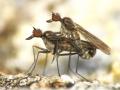
The species from Northeastern United States has been identified as Phortica variegata, a European species. The first known record from North America is from 2011 in Massachusetts (photo on bugguide.net). It is also known from Vermont (bugguide photo) and New York (collected by David Grimaldi). http://humanities...hilaguide/ |
|
|
|
| Jump to Forum: |