


Diptera.info :: Identification queries :: Diptera (adults)
 genitalia of Sarcophagidae
|
|
| tyrolean |
Posted on 17-03-2012 22:52
|
|
Member Location: Posts: 43 Joined: 24.05.10 |
I prepared the genitalia of a Sarcophaginae (mazeration in KOH), but I cannot really relate the parts to the descriptions. Maybe someone has an idea about the genus where this is from. (Sorry about the less than perfect quality)
tyrolean attached the following image: 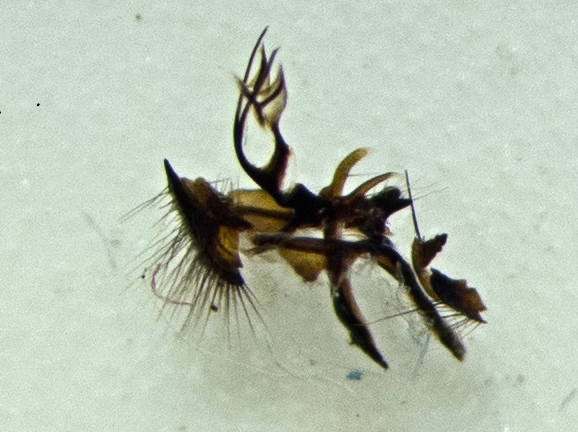 [187.62Kb] |
|
|
|
| tyrolean |
Posted on 19-03-2012 11:56
|
|
Member Location: Posts: 43 Joined: 24.05.10 |
I did not really expect an answer :-) |
|
|
|
| ChrisR |
Posted on 19-03-2012 12:04
|
 Super Administrator Location: Reading, England Posts: 7706 Joined: 12.07.04 |
Hmm, yeah I found it a bit tricky to work out ... are you sure that it is a sarcophagid? It doesn't remind me of any of the common Sarcophaga spp.  What does it key to in your books? What does it key to in your books?
Manager of the UK Species Inventory in the Angela Marmont Centre for UK Biodiversity at the Natural History Museum, London. |
 |
|
| Jan HC Velterop |
Posted on 19-03-2012 18:40
|
|
Member Location: Enschede NL 7544 ZE 106 Posts: 56 Joined: 08.03.06 |
Nice photo and easy to identify to genus - IF you have seen some thousands calliphorid genitalia: Pollenia R-D 1830. After comparison with the figures of Rognes 1991: 218-240, I feel rather sure it is just P. angustigena Wainwright 1940 $, p.222 fig 596. For confirmation see: P. angustigena = hairs on ventral side of tergites widely spaced; t2: 1 ad; t3 no av + v hairs; P. rudis = hairs on ventral side of tergites very dense, much denser as dorsal side; t2: 2-3ad; t3: on middle with longer erect av + v hairs beside the av-setae. Please, Let us know which species it is. Any Sarcophagida has completely different genitals, so all searching pictures is idle. |
|
|
|
| tyrolean |
Posted on 19-03-2012 23:24
|
|
Member Location: Posts: 43 Joined: 24.05.10 |
Hi Jan, So I seem to have made a serious mistake in family determination! In fact, I stumbled over couplet 187 in Oosterbroek which I bent to my preconceptions of a Sarcophagidae; now I see that Calliphoridae would have been correct. This tells me again that one cannot be too careful! Thanks a lot for pointing my mistake out!! The fly in question is in fact Pollenia rudis! Thanks again for solving this! |
|
|
|
| ChrisR |
Posted on 20-03-2012 08:48
|
|
Super Administrator Location: Reading, England Posts: 7706 Joined: 12.07.04 |
Yes, when you are starting out it is important to catch lots of flies and run them all through the family-level keys again and again to get experience of how they look. We all get fooled sometimes but (hopefully) less with experience  Pollenia are an easy genus to spot in the field because they have curly golden hairs on the thorax but these can be rubbed off in old specimens. But they do still have quite a distinctive appearance with tessellated dusting on the abdomen. Sarcophagidae are usually easy to distinguish from their very black & white chequered bodies; thorax with 3 black longitudinal stripes; reddish eyes and plumose arista. But of course there are always exceptions so there is no substitute for experience
Manager of the UK Species Inventory in the Angela Marmont Centre for UK Biodiversity at the Natural History Museum, London. |
|
|
|
| Jump to Forum: |