


Diptera.info :: Identification queries :: Diptera (adults)
 Black and white Mosquito
|
|
| aleix |
Posted on 17-04-2006 22:45
|
|
Member Location: Catalonia Posts: 51 Joined: 20.07.05 |
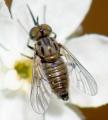
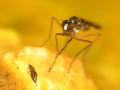
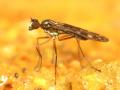
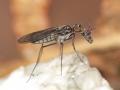
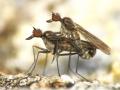
A friend of mine photographed this striking mosquito next to his house, in Girona, in Catalonia. He was afraid it might be an Aedes albopictus, but I've made a Google search and I think it is not, for it should have black and white legs and the antennae are too much plumed. Has anyone any idea of its identity? Thanks in advance! Aleix Comas aleix attached the following image: 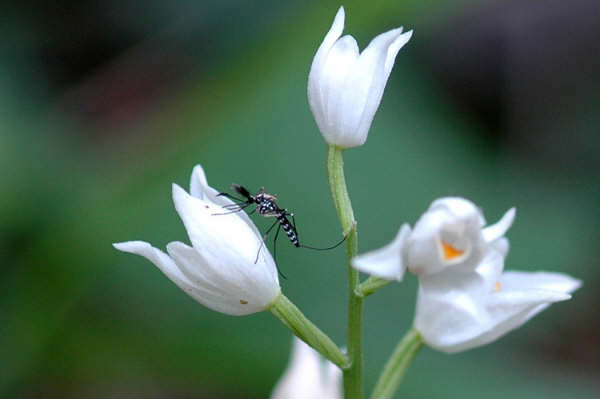 [18.38Kb] |
|
|
|
| Paul Beuk |
Posted on 18-04-2006 07:47
|
 Super Administrator Location: Netherlands Posts: 19403 Joined: 11.05.04 |
The Asian Tiger Mosquite, Aedes albopictus, apparently now also established in Italy and Spain. See: http://www.iberia...squito.htm. Quote from that site: There are as yet no known cases in Europe of vector-spread diseases from a tiger mosquito. However, although at this moment they may not be harmful, there is cause for concern. The tiger mosquito can be a vector for a whole litany of major diseases including dengue and yellow fever and West Nile. Aedes albopictus began to spread out from its Asian homeland in the 1970s, above all thanks to the sea transport of tyres. Moreover, the parent species Aedes aegypti, present as a result of previous ship-borne invasions, was the vector which caused severe outbreaks of dengue and yellow fever several centuries ago throughout the Mediterranean, though it was later eradicated. Both Aedes albopictus and Aedes aegypti share a similar habitat type and bionomics and bear the same vector diseases.
Paul - - - - Paul Beuk on https://diptera.info |
 |
|
| aleix |
Posted on 18-04-2006 09:22
|
|
Member Location: Catalonia Posts: 51 Joined: 20.07.05 |
Thanks very much In the pictures I've seen at Google, the legs were strikingly black and white wich doesn't seem to be the case in the picture I posted, that's why I thought it wasn't Aedes albopictus. So now that is a reason for concern! They say that its bites are very painful! Aleix |
|
|
|
| Zeegers |
Posted on 18-04-2006 21:19
|
|
Member Location: Soest, NL Posts: 19318 Joined: 21.07.04 |
By the way, on what flower ?? Looks like an orchid ? Theo |
|
|
|
| totipotent |
Posted on 19-04-2006 07:17
|
 Member Location: Texas A&M University, USA Posts: 21 Joined: 10.02.06 |
aleix wrote: A friend of mine photographed this striking mosquito next to his house, in Girona, in Catalonia. He was afraid it might be an Aedes albopictus, but I've made a Google search and I think it is not, for it should have black and white legs and the antennae are too much plumed. Has anyone any idea of its identity? Thanks in advance! Aleix Comas Aleix, That Mosquito's antennae are plumed because it is a male. Males only feed on flower nectar. There can be sexual dimorphism between genders of the same species (males look different than females). In addition, there are different strains and species complexes that exhibit different feeding behaviors and colorations. Though, male Aedes albopictus should have banded legs. The Walter Reed Biosystematics Unit's 2001 Systematic Catalog of the Culicidae shows only 10 Aedes species in Italy (albopictus, atropalpus, berlandi, caspius, hargreavesi, pulchritarsis, pullatus, rusticus, vexans, and vittatus). So if you haven't had any new introduced species since then, its one of those. If I had a dorsal view, I could tell you for certain. One clue that leads it to be albopictus is that this male is feeding during the day. Another name for Ae. albopictus is the "forest day mosquito." That?s just one of the reasons why they are considered a nuisiance. Another is that they don't just get a blood meal and leave... they take multiple feedings, so one mosquito feels like five mosquitoes. ...But it can be atropalpus (see hind femur), pullatus (in USA but I have never seen it) -OR- berlandi, caspius, hargreavesi, pulchritarsis, rusticus, and vittatus (all not in USA). It is definitely not Aedes vexans. ---------------------------------------------------------------------------------- |
|
|
|
| aleix |
Posted on 19-04-2006 10:29
|
|
Member Location: Catalonia Posts: 51 Joined: 20.07.05 |
We've written to the Mosquito Control Service, and Eduard Marqu?s, has told us it is not Aedes albopictus but a male of Ochlerotatus geniculatus. That is good news! By the way, Catalonia is not in Italy but in north-east of Spain and the south-east of France. Cheers, Aleix Comas |
|
|
|
| aleix |
Posted on 19-04-2006 10:35
|
|
Member Location: Catalonia Posts: 51 Joined: 20.07.05 |
By the way, the flower is an orchid, Cephalantera longifolia. Cheers, Aleix Comas |
|
|
|
| totipotent |
Posted on 19-04-2006 14:29
|
|
Member Location: Texas A&M University, USA Posts: 21 Joined: 10.02.06 |
aleix wrote: We've written to the Mosquito Control Service, and Eduard Marqu?s, has told us it is not Aedes albopictus but a male of Ochlerotatus geniculatus. That is good news! By the way, Catalonia is not in Italy but in north-east of Spain and the south-east of France. Cheers, Aleix Comas Ooopps... The Walter Reed Biosystematics Unit's 2001 Systematic Catalog of the Culicidae shows 23 Aedes (Ochlerotatus treated as a subgenus) species in Spain (berlandi, cantans, caspius, cataphylla, detritus, eatoni, echinus, flavescens, geminus, geniculatus, gilcolladoi, leucomelas, mariae, pulchritarsis, pullatus, punctor, quasirusticus, refiki, rusticus, sticticus, surcoufi, vexans, and vittatus). It appears Aedes albopictus arrived later see Paul's source). Sorry about the mistaken geography... ---------------------------------------------------------------------------------- |
|
|
|
| Jump to Forum: |