Gallery Links
Users Online
· Guests Online: 52

· Members Online: 0

· Total Members: 5,074
· Newest Member: Johann55
Forum Threads
Theme Switcher
Switch to:
Last Seen Users
· John Carr02:00:13
· Juergen Peters04:28:42
· weia04:45:17
· smol05:27:20
· evdb05:44:42
· piros09:27:52
· libor09:29:16
· Jordi Clavell09:41:35
· Oryctes10:50:00
· eklans11:28:11
Latest Photo Additions
View Thread
Diptera.info :: Identification queries :: Diptera (adults)
Who is here? 1 guest(s)
 Print Thread
next try to launch a Scathophagid
Sundew
#1 Print Post
Posted on 02-03-2008 23:41
User Avatar

Member

Location: Berlin and Baden-Württemberg, Germany
Posts: 3938
Joined: 28.07.07

Hi,
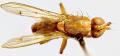
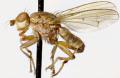
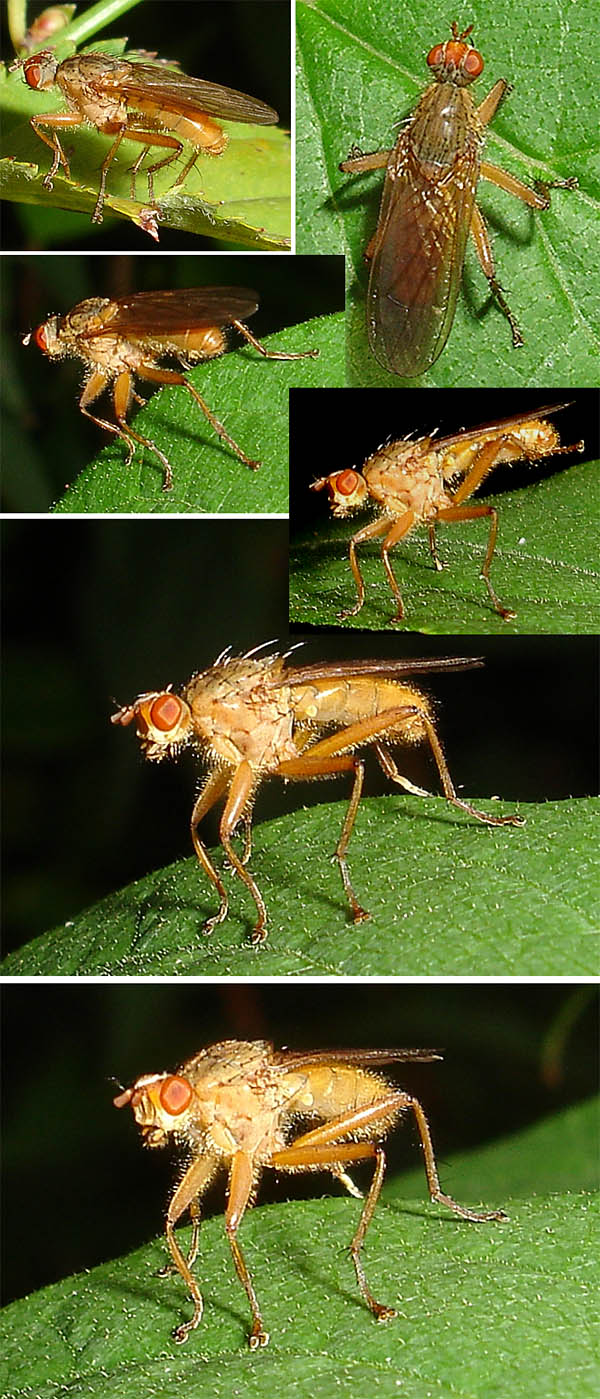
This yellow fly was around together with the Dryomyzid of my previous thread - same location, same day, not same species when seen through good spectacles or in big magnification (where is my good eyesight gone?). So is this a Scathophagid, for instance Scathophaga suilla?
Regards, Sundew
Sundew attached the following image:

[186.26Kb]
Edited by Sundew on 03-03-2008 16:41
 
Xespok
#2 Print Post
Posted on 03-03-2008 08:03
User Avatar

Member

Location: Debrecen, Hungary
Posts: 5551
Joined: 02.03.05

This is Scathophaga sp. The fly does not have a black area on its forefemur, which rules out a host of species. The antennae are not dark, which would indicate stercoraria, but at this stage without the key I would leave it there.

EDITED: Sorry for my mistake, I meant to write contraindicate S. stercoraria...
Edited by Xespok on 03-03-2008 17:49
Gabor Keresztes

Japan Wildlife Gallery
Carpathian Basin Wildlife Gallery
 
Teglagyar u. 30.
Sundew
#3 Print Post
Posted on 03-03-2008 16:45
User Avatar

Member

Location: Berlin and Baden-Württemberg, Germany
Posts: 3938
Joined: 28.07.07

Dear Gabor, thanks for confirming the genus. However, all the Scathophaga stercoraria specimens I've seen were much hairier and also bigger. In the gallery, there are several species with antennae not dark, and the pics of S. suilla look quite similar...
Sundew
 
Kahis
#4 Print Post
Posted on 03-03-2008 17:46
User Avatar

Member

Location: Helsinki, Finland
Posts: 1999
Joined: 02.09.04

My first though was definitely S. suilla, but that species should not have strong setae on hind femora. If the arista is hairy, that would take us to S. lutaria or S. inquinata.
Kahis
 
www.iki.fi/kahanpaa
Sundew
#5 Print Post
Posted on 04-03-2008 01:10
User Avatar

Member

Location: Berlin and Baden-Württemberg, Germany
Posts: 3938
Joined: 28.07.07

No chance to see hairs or not on the aristae - I checked all my pics, but this is beyond the limits of my camera! So it is Scathophaga for sure but the species remains nebulous... Well, better than nothing.
Many thanks to all contributors,
Sundew
 
Jump to Forum:
Similar Threads
Thread Forum Replies Last Post
extreme Scathophagid Diptera (adults) 6 02-07-2023 16:38
Scathophagid for ID Diptera (adults) 2 18-08-2021 10:15
Scathophagid looking like Sciomyzid Diptera (adults) 2 11-03-2021 20:05
Scathophagid Diptera (adults) 3 15-09-2020 23:11
Unknown => Scathophagid, Nanna Diptera (adults) 4 09-06-2017 16:19
Date and time
14 December 2025 05:19
Login
Username

Password


Not a member yet?
Click here to register.

Forgotten your password?
Request a new one here.
Temporary email?
Due to fact this site has functionality making use of your email address, any registration using a temporary email address will be rejected.

Paul
Donate
Please, help to make
Diptera.info
possible and enable
further improvements!
Latest Articles
Syrph the Net
Those who want to have access to the Syrph the Net database need to sign the
License Agreement -
Click to Download


Public files of Syrph the Net can be downloaded HERE

Last updated: 25.08.2011
Shoutbox
You must login to post a message.

06.12.25 21:37
He last posted here in April, identifying some Chloropidae.

04.12.25 20:02
Dr Michael von Tschirnhaus, a leading expert on Chloropidae and Agromyzidae, died on 16 September 2025 at the age of 86. He will be greatly missed by the international community. R.I.P.

03.12.25 12:46
Anyone has the scan of "Harkness, R. D.; Ismay, J. W. 1976: A new species of Trachysiphonella (Dipt., Chloropidae) from Greece, associated with an ant Cataglyphis bicolor (F.) (Hym., Formicidae)

01.12.25 22:29
I will try to fix the messages this month. We have to make some other configuration changes before software goes out of support at end of year.

29.11.25 21:57
I would prefer not to receive any more messages from diptera.info signed by Paul... (Thread reply notification)... Could they be signed by ‘The diptera.info team’?

19.11.25 12:31
It is with deepest sadness in my heart that I announce that on Saturday, November 15, one of the great minds of world dipterology, prof. Rudolf Rozkošny, left us forever. Please remember him with a

15.08.25 10:15
For those specialists not active on Facebook, I just ask to consider to join our group on FB. Please, be aware that it is not necessary at all to be active on FB outside the diptera group. Actually, n

15.08.25 10:13
We received requests to get permission to ask for ID in our Facebook group, https://www.facebo
ok.com/groups/1798
95332035235/ Until now we pointed to diptera.info, but since Paul's passing we not

23.06.25 18:10
If you have some spare money, there is a copy (together with keys to pupae and larvae) for sale by Hermann L. Strack, Loguivy Plougras, France

23.06.25 11:18
Appreciate it, Tony Irwin! I got the hint to use the key next to Langton and Pinder key for females of Chironomidae. So no specific queries, except the keys... I will keep this on my list and hope th

Render time: 0.65 seconds | 251,888,767 unique visits