


Diptera.info :: Identification queries :: Diptera (adults)
 Muscidae: Mydaea flavicornis
|
|
| Steve Scholnick |
Posted on 06-11-2019 05:02
|
|
Member Location: Maryland, USA Posts: 129 Joined: 25.12.17 |
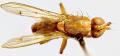
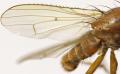
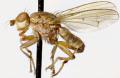
This battered and bruised muscid was dying as I started to photograph it and there are lots of broken and missing bristles. The body is ~6mm long. Found in a densely populated suburban area of Maryland. It appears to be Mydaea based on the Huckett & Vockeroth key in the Manual of the Nearctic Diptera. I could be (probably am) way off so here are the character states from the key that I think I see: anepimeron bare; hind tibia with only a preapical middorsal bristle, Sc very close to R over most of its length; hind coxa without setae on posterior surface; hairs at node of Rs/base of R4+5; prosternum bare; Last section of M not curved forward; katepisternum with three major bristles (+1 that is distinctly smaller than the usual 3 but much larger than a hair), legs yellow; eye bare. On the assumption that this genus ID might be correct, I tried Snyder's 1949 key to Mydaea (http://digitallib.../2246/4273). What I get is Mydaea flavicornis Coquillett: dorsocentrals 2:4; scutellum yellow, contrasting sharply with the dark thoracic disc; palpi and antennae fulvous; lateral ventral margins of scutellum with some black bristles. After all that, I'd greatly appreciate someone with expertise telling me what it really is. Thanks in advance Regards Steve     ventral view of whole wing & inset of dorsal view of Rs node    "L" = view of left hind tibia from above & behind. "R" = anterior face of right hind tibia & tarsi  view of posterior site of hind coxae   prosternum  katepisternum 
Steve Scholnick attached the following image: 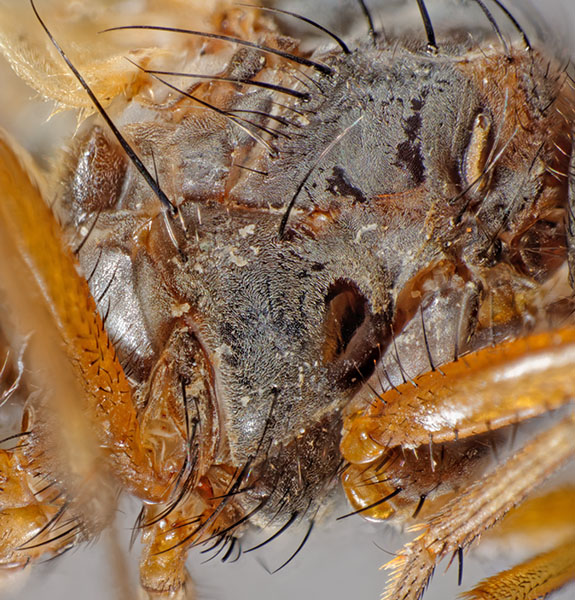 [143.82Kb] Edited by Steve Scholnick on 09-10-2022 23:09 |
|
|
|
| Steve Scholnick |
Posted on 08-11-2019 21:30
|
|
Member Location: Maryland, USA Posts: 129 Joined: 25.12.17 |
no one willing to break the bad news that it's really a grasshopper? :-) |
|
|
|
| Nikita Vikhrev |
Posted on 08-11-2019 21:57
|
 Member Location: Moscow, Russia Posts: 9561 Joined: 24.05.05 |
Steve, everything fits Mydaea. My doubts concern your image of scutellum with hairs on the ventral side. It seems that Palaearctic Mydaea have not these hairs. Next week I'll try to check it. So far, 100% not grasshopper! Nikita Vikhrev - Zool Museum of Moscow University |
|
|
|
| Steve Scholnick |
Posted on 08-11-2019 22:43
|
|
Member Location: Maryland, USA Posts: 129 Joined: 25.12.17 |
Hi Nikita, Thanks for looking at the photos. When I try to ID something as a muscid, it could very well be a grasshopper :-) Here's what Snyder's paper says about M. flavicornis: "Mydaea flavicornis Coquillett Mydatea flavicornis COQUILLETT, 1902, Proc. U. S. Natl. Mus., vol. 25, p. 122; STEIN,1920, Arch. Naturgesch., sect.A, vol.84, p.26; MALLOCH, 1921,Canadian Ent., vol.51, p.10; 1923, ibid.,vol.55, p.220. MALE: Length 5mm. Very similar to impedita Stein, differing from it in having the humeri entirely darkened. The scutellum with a row of distinct setulae along the ventral margin on the basal half. Midtibiae with only two median posterior bristles. Hind tibiae with two anterodorsal and two or three anteroventral bristles. Abdomen with distinct dorsocentral vitta, and the fifth sternite with only two or three bristles on the disc of the processes. FEMALE: Length 6 to 7mm. Similar to the male, differing from it in having the front one-fourth of head width at vertex and of almost uniform width throughout. The humeri distinctly yellowish as in impedita Stein. SPECIMENS EXAMINED: Five males and four females from Missouri, Wisconsin, Indiana, Pennsylvania, New York, and the holotype male in the United States National Museum from Quebec." He uses the ventral scutellar bristles as the distinguishing character between M. flavicornis and M. impedita in couplet 4 ("Lateral ventral margins of scutellum with some black bristles" vs. "Lateral ventral margins of scutellum bare"). Whether that's actually correct, I'll leave to you :-) Regards Steve |
|
|
|
| Nikita Vikhrev |
Posted on 08-11-2019 22:59
|
|
Member Location: Moscow, Russia Posts: 9561 Joined: 24.05.05 |
I told you it wasn't a grasshopper! One question: I have not Snyder's paper you have cited. Do you have its pdf? Nikita Vikhrev - Zool Museum of Moscow University |
|
|
|
| Steve Scholnick |
Posted on 08-11-2019 23:05
|
|
Member Location: Maryland, USA Posts: 129 Joined: 25.12.17 |
I just emailed you a PDF copy. It's on the large size for an attachment so, if it doesn't arrive, the download URL is http://digitallib.../2246/4273 |
|
|
|
| Nikita Vikhrev |
Posted on 08-11-2019 23:07
|
|
Member Location: Moscow, Russia Posts: 9561 Joined: 24.05.05 |
Thank you, Steve!
Nikita Vikhrev - Zool Museum of Moscow University |
|
|
|
| Jump to Forum: |