


Diptera.info :: Identification queries :: Diptera (adults)
 Green chiro
|
|
| Lippo |
Posted on 26-09-2019 08:50
|
|
Member Location: Posts: 259 Joined: 28.08.18 |
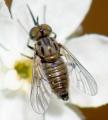
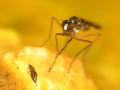
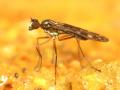
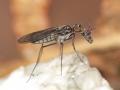
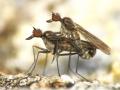
SW France yesterday. Body length around 5 mm. I think it is Chironomus, but could we go further with the subgenus and possibly the species ? 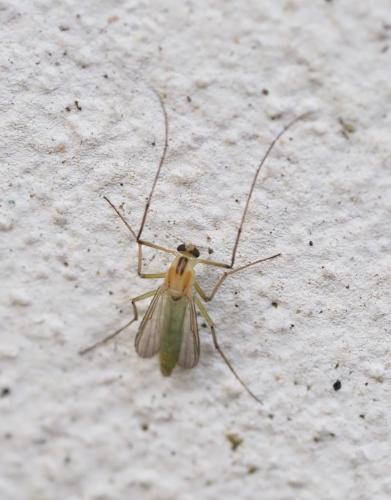 Daniel Philippe : France : Sainte-Livrade-sur-Lot : 47110 : 25/09/2019 Altitude : 45 m - Taille : 7 mm estimé Réf. : 240772 |
|
|
|
| Tony Irwin |
Posted on 26-09-2019 09:26
|
 Member Location: Norwich, England Posts: 7352 Joined: 19.11.04 |
I think this is more like one of the Tanytarsini. I'm not able to suggest a genus with confidence.
Tony ---------- Tony Irwin |
|
|
|
| Lippo |
Posted on 26-09-2019 09:39
|
|
Member Location: Posts: 259 Joined: 28.08.18 |
Ah yes ! many thanks Tony,  |
|
|
|
| John Carr |
Posted on 26-09-2019 12:47
|
 Super Administrator Location: Colorado, USA Posts: 10662 Joined: 22.10.10 |
Tribe Chironomini. I have been wondering if these midges with the divided central stripe are Chironomus macani. The American relatives have a similar divided stripe. |
 |
|
| Tony Irwin |
Posted on 26-09-2019 15:23
|
|
Member Location: Norwich, England Posts: 7352 Joined: 19.11.04 |
Happy to accede to John's deeper knowledge on this family!
Tony ---------- Tony Irwin |
|
|
|
| Lippo |
Posted on 26-09-2019 16:13
|
|
Member Location: Posts: 259 Joined: 28.08.18 |
Many thanks John, This family is really a nightmare for me. I wish I could find a key to distinguish sub-families and tribes from each other for the adults. Edited by Lippo on 26-09-2019 16:20 |
|
|
|
| John Carr |
Posted on 26-09-2019 18:34
|
|
Super Administrator Location: Colorado, USA Posts: 10662 Joined: 22.10.10 |
Fore legs usually held with femora vertical, fore basitarsus at least nearly as long as and usually distinctly longer than fore tibia, with short to long dorsal eye extension, vein M ending beyond wingtip in common species, crossvein m-cu absent and those veins well separated, usually warm weather species and usually aquatic, wings usually unmarked but occasionally with poorly-defined bands or spots (see Polypedilum and Demeijerea), often large: Chironominae Fore legs with fore basitarsus not much longer than and usually much shorter than tibia, eye extension usually short to absent, vein M ending not ending far behind wingtip, crossvein m-cu absent and those veins well separated, tarsomere 4 rarely enlarged (exceptions in Cardiocladius and littoral or marine species), usually cool weather species and often terrestrial, wings unmarked at least in European species, rarely large: Orthocladiinae Like Orthocladiinae but veins M and Cu close together joined by a crossvein, vein R-M long and not perpendicular to wing axis, tarsomere 4 of common species short and enlarged, female antenna usually with more flagellomeres than previous families, usually cold weather species, wings unmarked: Diamesinae Fore basitarsus shorter than tibia, female antenna with more than 10 flagellomeres, male with penultimate flagellomere longest (last flagellomere longest in other subfamilies except when male has female-like antennae), crossvein m-cu present, crossvein r-m usually shorter than in Diamesinae, wing usually hairy at least distally, vein R2+3 usually forked (often hard to see), usually with dorsal eye extension, tarsomere 4 rarely enlarged (one exception in Europe), wings often marked at least by dense hairs forming apparent dark patches, warm weather species, small to large: Tanypodinae |
|
|
|
| Lippo |
Posted on 26-09-2019 18:48
|
|
Member Location: Posts: 259 Joined: 28.08.18 |
Wow ! thanks a lot, this is great, I am aware I am very demanding, but could we have the same to tell apart Chironomini from Tanytarsini: this would be terrific. Edited by Lippo on 26-09-2019 19:00 |
|
|
|
| John Carr |
Posted on 26-09-2019 19:33
|
|
Super Administrator Location: Colorado, USA Posts: 10662 Joined: 22.10.10 |
Tanytarsini usually have hairy wings, reduced dorsal eye extension, reduced anal lobe of wings, and vein R ending near wingtip. Male tergite 8 is often constricted at front. Crossvein r-m is more or less parallel to wing axis. They are usually small and are rarely photographed. The common species fly in spring before Chironomini. Chironomini rarely have hairy wings (exceptions in Polypedilum and some related genera, and in Kiefferulus). Vein M usually ends behind wingtip (exceptions in Polypedium and some genera that don't really belong in Chironomini). Almost all species have a long dorsal eye extension. Tergite 8 is unmodified except in Polypedilum. The anal lobe is often large. Crossvein r-m forms a distinct angle to the veins it connects to and is usually perpendicular to wing axis. They are often large, to 15 mm. I forgot to mention Stenochironomus among the genera of Chironominae with marked wings. The wing markings have well-defined edges when present. You also have one species of Pseudochironomini in Europe. Vein M ends near wingtip, dorsal eye extensions are small, and fore basitarsus is short. |
|
|
|
| Lippo |
Posted on 26-09-2019 20:49
|
|
Member Location: Posts: 259 Joined: 28.08.18 |
Many thanks again John, I will feel much more comfortable now when I see these little midges around here. I will not have to spend a lot of time just to compare photos on the web and achieve a result as if I had played dice.  |
|
|
|
| Jump to Forum: |