


Diptera.info :: Identification queries :: Diptera (adults)
 Muscidae ID -> Muscina stabulans
|
|
| Carnifex |
Posted on 15-08-2019 21:19
|
 Member Location: Vienna, Austria Posts: 2052 Joined: 23.06.15 |
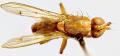
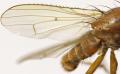
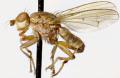
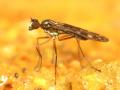
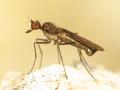
Hi, this 5mm long fly was attracted to a beer bait in a garden in Vienna. I was looking for the 'Phaonia bristle', but I am not sure if it is present here or not.    
Edited by Carnifex on 20-08-2019 22:05 Cheers, Lorin Font Color All requests are from the urban area of Vienna, if not otherwise stated. My Diptera observations (and other living forms) can be found here, and corrections or comments over there would also be appreciated. |
|
|
|
| Nikita Vikhrev |
Posted on 16-08-2019 13:04
|
 Member Location: Moscow, Russia Posts: 9561 Joined: 24.05.05 |
Phaonia bristle presents, but it is Muscina stabulans
Nikita Vikhrev - Zool Museum of Moscow University |
|
|
|
| Carnifex |
Posted on 16-08-2019 13:26
|
|
Member Location: Vienna, Austria Posts: 2052 Joined: 23.06.15 |
Thank you Nikita, at the same time, there were several other Muscina (stabulans/levida), but this fly was much smaller than the others. Is there such a variety in body sizes? Edited by Carnifex on 16-08-2019 13:26 Cheers, Lorin Font Color All requests are from the urban area of Vienna, if not otherwise stated. My Diptera observations (and other living forms) can be found here, and corrections or comments over there would also be appreciated. |
|
|
|
| Nikita Vikhrev |
Posted on 16-08-2019 14:57
|
|
Member Location: Moscow, Russia Posts: 9561 Joined: 24.05.05 |
Well, probably when she was larva, she feeded bad...
Nikita Vikhrev - Zool Museum of Moscow University |
|
|
|
| johnes81 |
Posted on 16-08-2019 15:01
|
 Member Location: Berlin, Germany Posts: 1980 Joined: 15.10.16 |
very strange because it only has three stripes on the mesonotum. I am used to seeing four stripes with two prominent median stripes. She is strange. Maybe she drank too much beer 
John and Nini. Naturalists not experts. |
|
|
|
| Carnifex |
Posted on 17-08-2019 19:01
|
|
Member Location: Vienna, Austria Posts: 2052 Joined: 23.06.15 |
So what you say, John, is that you agree with the ID, only that it is an unusual individual - or do you suggest to take a closer look at that fly?
Cheers, Lorin Font Color All requests are from the urban area of Vienna, if not otherwise stated. My Diptera observations (and other living forms) can be found here, and corrections or comments over there would also be appreciated. |
|
|
|
| johnes81 |
Posted on 19-08-2019 12:59
|
|
Member Location: Berlin, Germany Posts: 1980 Joined: 15.10.16 |
Hello Lorin, I hope that you are having a good day. I am stunned by the dusting on the thorax. I've not seen this on M. stabulans. I have various angles but always see two vitta. Perhaps you are a much better photographer and captured the right photo to show a strong dusting. The pale areas could become dark (dusting) while the dark areas become pale. I am not a Muscidae expert so i cannot disagree with M. stabulans. M. angustifrons is very similar but also very rare and associated with fungus. I'm going to try to find a stabulans with such dusting. I'm curious why i have not seen this before ... Best wishes, John John and Nini. Naturalists not experts. |
|
|
|
| Carnifex |
Posted on 20-08-2019 08:47
|
|
Member Location: Vienna, Austria Posts: 2052 Joined: 23.06.15 |
I can exclude M. angustifrons, the apical femora are reddish and the basicosta is yellow. Also, the weird striping is just a light effect, viewing it from a different angle it looks like this, so never trust a photo :-)
Cheers, Lorin Font Color All requests are from the urban area of Vienna, if not otherwise stated. My Diptera observations (and other living forms) can be found here, and corrections or comments over there would also be appreciated. |
|
|
|
| johnes81 |
Posted on 20-08-2019 13:55
|
|
Member Location: Berlin, Germany Posts: 1980 Joined: 15.10.16 |
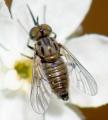
I decided to look at my photos of levida, stabulans and prolapsa. I only see the dusting from the front when the fly is alive. Your fly is clearly dead, so the dusting is visible from behind. Try it on a live specimen. I find this interesting. I like to document dusting (light plays a role but it is really dusting that you are seeing not an effect of light), I also have Phaonia turgoriorum scutellum with two different colors based upon angle (dusting). I find dusting to be fascinating and i like to document it. I will attach a photo depicting the dusting from the front of M. levida (left) and M. stabulans (right). I only photograph live flies, so this is nice to know. johnes81 attached the following image: 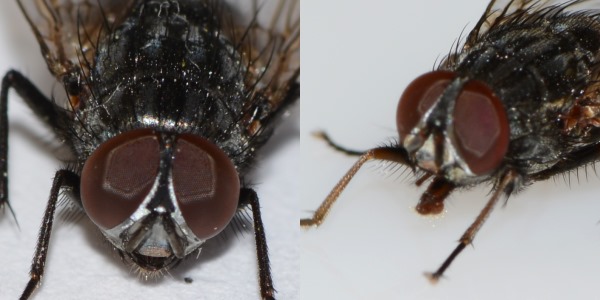 [46.29Kb] John and Nini. Naturalists not experts. |
|
|
|
| Jump to Forum: |