


Diptera.info :: Identification queries :: Diptera (adults)
Who is here? 1 guest(s)
 livida vs vicina
|
|
| Tony T |
Posted on 28-08-2007 01:16
|
 Member Location: New Brunswick, Canada Posts: 664 Joined: 08.02.07 |
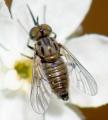
We have both of these species of Calliphora in New Brunswick, Canada; (May 2007) Can be separated by the cheek colour and as Susan wrote HERE Susan R Walter wrote: .................... the enfuscation of the squamae, with the lower one very dark [in vomitaria] with a very narrow very white edge. Vicina has a broad white edge, so this feature can be useful when you don't have such a good view of the face. (Beware loewi and uralensis if in this situation of course.) EDIT: the above comments were written when I thought one of the flies was vomitoria. The fly is actually Calliphora livida Tony T attached the following image: 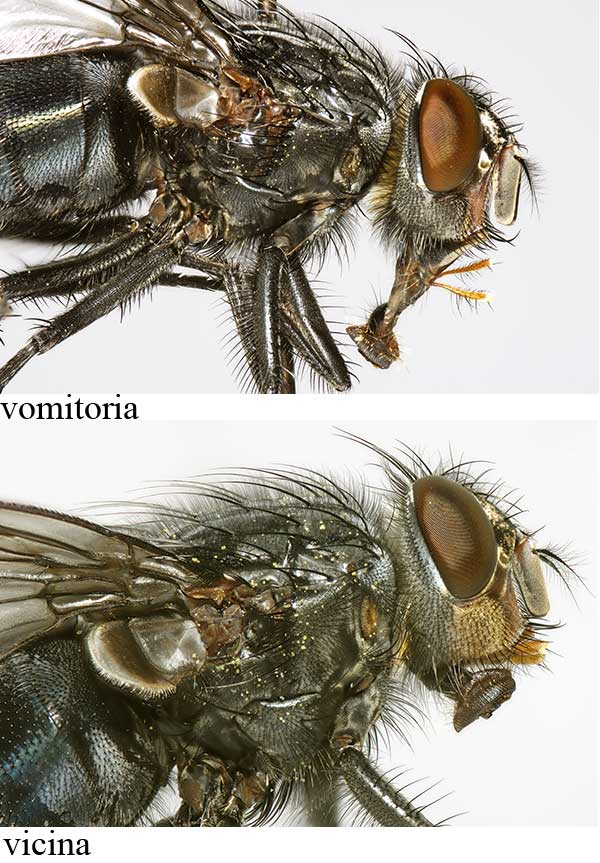 [97.27Kb] Edited by Tony T on 29-08-2007 04:37 |
|
|
|
| Tony Irwin |
Posted on 28-08-2007 12:49
|
 Member Location: Norwich, England Posts: 7346 Joined: 19.11.04 |
Hi Tony - I agree with your ID of vicina, but the top image does not look like vomitoria to me (not enough orange hair on the cheeks). There are several other species of Calliphora in your region, and this is probably one of them. Terry Whitworth has produced a key to the North American Calliphoridae - you can download it from http://www.birdbl...worth.html (Whitworth, Terry L. 2006) Edited by Tony Irwin on 28-08-2007 12:55 Tony ---------- Tony Irwin |
|
|
|
| Susan R Walter |
Posted on 28-08-2007 13:04
|
 Member Location: Touraine du Sud, central France Posts: 1802 Joined: 14.01.06 |
Tony Are you certain the top one is vomitoria? Brown basicosta and epaulettes (should be black in vomitoria), yellowy brown anterior spiracle (should be black in vomitoria, the white border on the lower calypter is not a threadlike white line around the edge. Both specimens have ginger hair behind the occiput, which vicina can have, but no red hair on the genae, which vomitoria should have and I am wondering if both are vicina, or the top one is some third species - what do you get in North America? I take it you have the specimens? Susan |
 |
|
| Zeegers |
Posted on 28-08-2007 17:57
|
|
Member Location: Soest, NL Posts: 19310 Joined: 21.07.04 |
I had my doubts too. On the other hand, I know from Siberia that vomitoria is unusually dark there, to our standards. The genitalia are distinctive. So that should setlle the matter. But Susan is right: to us West-Europeans the vomitoria is quite atypical, if it really is vomitoria. Theo |
|
|
|
| Tony T |
Posted on 28-08-2007 18:09
|
|
Member Location: New Brunswick, Canada Posts: 664 Joined: 08.02.07 |
Thank you all for your useful comments. I have made a copy of the Whitworth paper. I used this key HERE to ID the species but obviously I went wrong somewhere. I do have the specimen and will get to work this evening on its correct identification and look at other specimens to see if I do have a vomitoria. Incidentally these 2 flies and dozens of others (not all collected) were common in a rotten-fish-bait trap in my garden this past May. |
|
|
|
| Susan R Walter |
Posted on 28-08-2007 19:32
|
|
Member Location: Touraine du Sud, central France Posts: 1802 Joined: 14.01.06 |
Tony I - That article you suggested looks great - some really clear useful looking drawings especially. Tony T - the North Kentucky University Forensic Fly Key is useful because it shows closeups of tricky characters, but it only includes a couple of species from each genera - bit of a trap. Susan |
|
|
|
| Zeegers |
Posted on 28-08-2007 21:02
|
|
Member Location: Soest, NL Posts: 19310 Joined: 21.07.04 |
Tony T, We didn't say you went wrong, we had our doubts. Your 'vomitoria' most certainly is not vicina and it could prove to be vomitoria after all. We just don't know the alternatives in your univers (= new world) Theo |
|
|
|
| Tony Irwin |
Posted on 29-08-2007 00:04
|
|
Member Location: Norwich, England Posts: 7346 Joined: 19.11.04 |
Tony T wrote: I used this key HERE to ID the species but obviously I went wrong somewhere. Tony - The only place you went wrong was to use a "key to common forensically important blowflies of Northern Kentucky" to identify potentially uncommon blowflies from New Brunswick!  It seems to me you reached the right answer in that key. 
Tony ---------- Tony Irwin |
|
|
|
| Tony T |
Posted on 29-08-2007 04:32
|
|
Member Location: New Brunswick, Canada Posts: 664 Joined: 08.02.07 |
You folks are smart, you certainly know your flies. Ran the specimen through Whitworth's key, definitely Calliphora. Got to couplet 5 in species key, critical character is number of postsutural intra-alar setae. 2 in vicina and vomitoria and some other species. My specimen has 3 = livida or coloradensis, the black genal dilation keys to livida vs. reddish dilation in coloradensis. Thanks to you all for comments. |
|
|
|
| Zeegers |
Posted on 29-08-2007 07:43
|
|
Member Location: Soest, NL Posts: 19310 Joined: 21.07.04 |
Congratulaions to Tony and Susan for getting the solution. Theo |
|
|
|
| Jump to Forum: |