

Diptera.info :: Identification queries :: Diptera (adults)
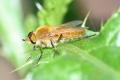
 Thereva cf. fulva
|
|
| Sundew |
Posted on 13-07-2016 00:29
|
 Member Location: Berlin and Baden-Württemberg, Germany Posts: 3939 Joined: 28.07.07 |
Hi, Some days ago I saw this nice Thereva, and with the key by van Veen (http://home.hccne...ml#Thereva) T. nobilitata was identified without much difficulty. However, I would like to ask why I had to start with "Femora largely or entirely black" - to me they show a light grey at best. Of course it is not the alternative T. aurata, but I have also seen brownish femora like in this case: http://www.dipter...to_id=3733. Perhaps it is just a matter of dusting, but there are, e.g., many green weevils that become dark when losing their scales, and nobody would a priori call them "black"... Thanks for comments, Sundew Sundew attached the following image: 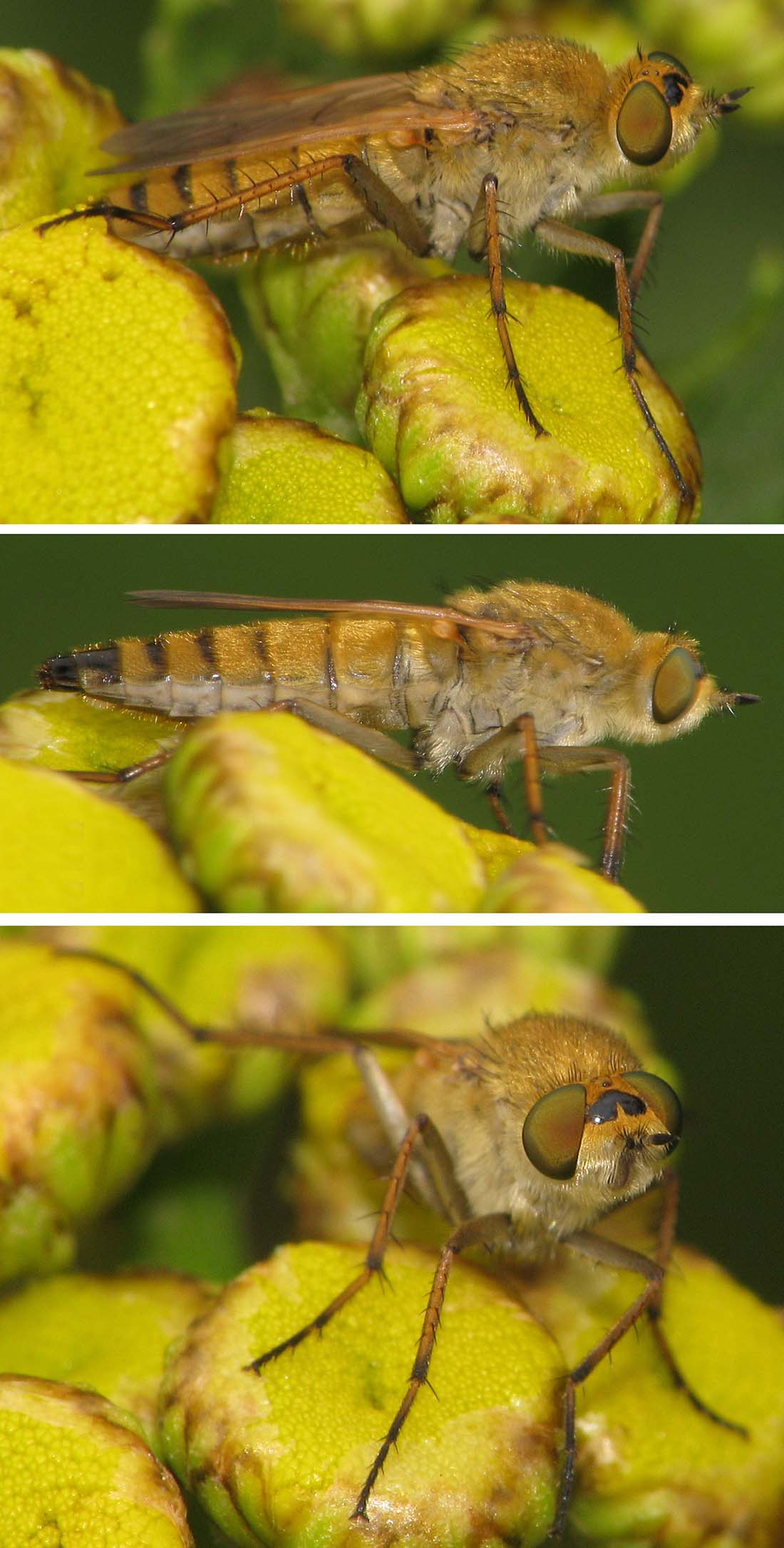 [177.87Kb] Edited by Sundew on 14-07-2016 20:19 |
|
|
|
| ValerioW |
Posted on 13-07-2016 06:16
|
 Member Location: Padova - Italy Posts: 982 Joined: 01.06.12 |
For me it doesn't fit with nobilitata. I'd say Female T. cf. fulva. Hairs along tergites/sternites are wholly pale
Edited by ValerioW on 13-07-2016 07:00 |
|
|
|
| ValerioW |
Posted on 13-07-2016 07:06
|
|
Member Location: Padova - Italy Posts: 982 Joined: 01.06.12 |
Next week I will be able to get the "Die Fliegen der Palaearktischen Region" about Bombyliidae and Therevidae. So, could be interesting to check it again. |
|
|
|
| Zeegers |
Posted on 13-07-2016 09:22
|
|
Member Location: Soest, NL Posts: 19461 Joined: 21.07.04 |
I agree it looks weird. As for the femora, they are dark covered with grey dusting, that qualifies as dark. The frontal callus is too big for nobilitata. The black bands on tergites definitely contradict fulva. It seems there is only one post DC (?), which would contradict handlirschi. Still, it must be something like handlirschi / lanata. Theo |
|
|
|
| Zeegers |
Posted on 13-07-2016 09:22
|
|
Member Location: Soest, NL Posts: 19461 Joined: 21.07.04 |
By the way, Lindner is completely outdated on this. Theo |
|
|
|
| Zeegers |
Posted on 13-07-2016 09:26
|
|
Member Location: Soest, NL Posts: 19461 Joined: 21.07.04 |
Van der Goot (1985) gives a comment on fulva vs. very yellow nobilitata: the shape of the callus is decisive. However, in this case, it is intermediate. I would not dare to call this one. I am afraid it is nobilitata after all. Theo |
|
|
|
| ValerioW |
Posted on 13-07-2016 10:01
|
|
Member Location: Padova - Italy Posts: 982 Joined: 01.06.12 |
Zeegers wrote: By the way, Lindner is completely outdated on this. Theo Cannot disagree. But about Bombyliidae there isn't much more around, unfortunately. |
|
|
|
| ValerioW |
Posted on 13-07-2016 10:07
|
|
Member Location: Padova - Italy Posts: 982 Joined: 01.06.12 |
Zeegers wrote: Van der Goot (1985) gives a comment on fulva vs. very yellow nobilitata: the shape of the callus is decisive. However, in this case, it is intermediate. I would not dare to call this one. I am afraid it is nobilitata after all. Theo Really? Sternites are not matching perfectly for fulva, but abdominal hairs and callus (kind of bilobate) really make me think isn't a nobilitata. Quite curious specimen |
|
|
|
| ValerioW |
Posted on 13-07-2016 10:08
|
|
Member Location: Padova - Italy Posts: 982 Joined: 01.06.12 |
I've excluded handlirschi because of T7 hairs (I know, this photo isn't a macro/micro, so there's a big chance of risk), that appear pale.
Edited by ValerioW on 13-07-2016 10:14 |
|
|
|
| Zeegers |
Posted on 13-07-2016 11:18
|
|
Member Location: Soest, NL Posts: 19461 Joined: 21.07.04 |
yes, the callus is intermediate. Van der Goot, as one of the few, mentions nobilitata with yellow tergites 2-3. So this obviously is an - often ignored - pitfall. Hence, I will not call this one Theo |
|
|
|
| ValerioW |
Posted on 13-07-2016 11:28
|
|
Member Location: Padova - Italy Posts: 982 Joined: 01.06.12 |
Guess it is still the best option  |
|
|
|
| Sundew |
Posted on 13-07-2016 11:54
|
|
Member Location: Berlin and Baden-Württemberg, Germany Posts: 3939 Joined: 28.07.07 |
Wow - what a discussion! And it was so simple with the van Veen key... He writes concerning confusion with T. fulva: "T. nobilitata might have tergite 2-3 almost completely dusted, but the black frontal spot does not reach the front ocellus." Which is true here. And T. handlirschi is said to have blackish halteres - here clearly yellowish to brownish, so T. nobilitata. As to the shape of the callus, there is only one option for all females except T. valida: "Frons with a broad spot that is about as high as long". No further differentiation. So my conclusion is: you do not trust this key, though it is based on van der Goot (1985), the situation is more complicated. Bad for me! So it's T. cf. nobilitata then. Thanks! Sundew Edited by Sundew on 13-07-2016 11:54 |
|
|
|
| Zeegers |
Posted on 14-07-2016 08:00
|
|
Member Location: Soest, NL Posts: 19461 Joined: 21.07.04 |
I do trust the remark by Van der Goot, repeated by Van Veen. I think it is a very useful warning. However, in my opinion Van der Goot underestimates the variability of the shape of the callus. In any case, I think you might agree that this callus fits neither of his descriptions..... Theo |
|
|
|
| Sundew |
Posted on 14-07-2016 13:41
|
|
Member Location: Berlin and Baden-Württemberg, Germany Posts: 3939 Joined: 28.07.07 |
I see. I have only the van Veen key, not van der Goot's original. If the callus shape is thus important (and it seems too close to the front ocellus for T. nobilitata indeed), we should declare this female the same as in my old thread http://www.dipter...d_id=31414 and name it T. cf. fulva... |
|
|
|
| Jump to Forum: |