

Diptera.info :: Identification queries :: Diptera (adults)
Who is here? 1 guest(s)
 Dolichopodidae (1) - the earthworm battle
|
|
| Sundew |
Posted on 29-06-2014 23:14
|
 Member Location: Berlin and Baden-Württemberg, Germany Posts: 3939 Joined: 28.07.07 |
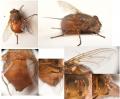
Hi, Some weeks ago I watched a lot of Dolis, belonging to different taxa, on a wet forest track in southern Brandenburg. I was surprised that some of them hunted small earthworms. Though the worm finally made its escape, parts of it were bitten off by the flies. I read that Dolis prey on Enchytraeids (http://www.zfmk.d...0H12S5.PDF) but did not find any information about Lumbricids as prey. Can the flies be identified? I hope all the pictures show the same species, as there were so many flies around. Many thanks for help, Sundew Sundew attached the following image: 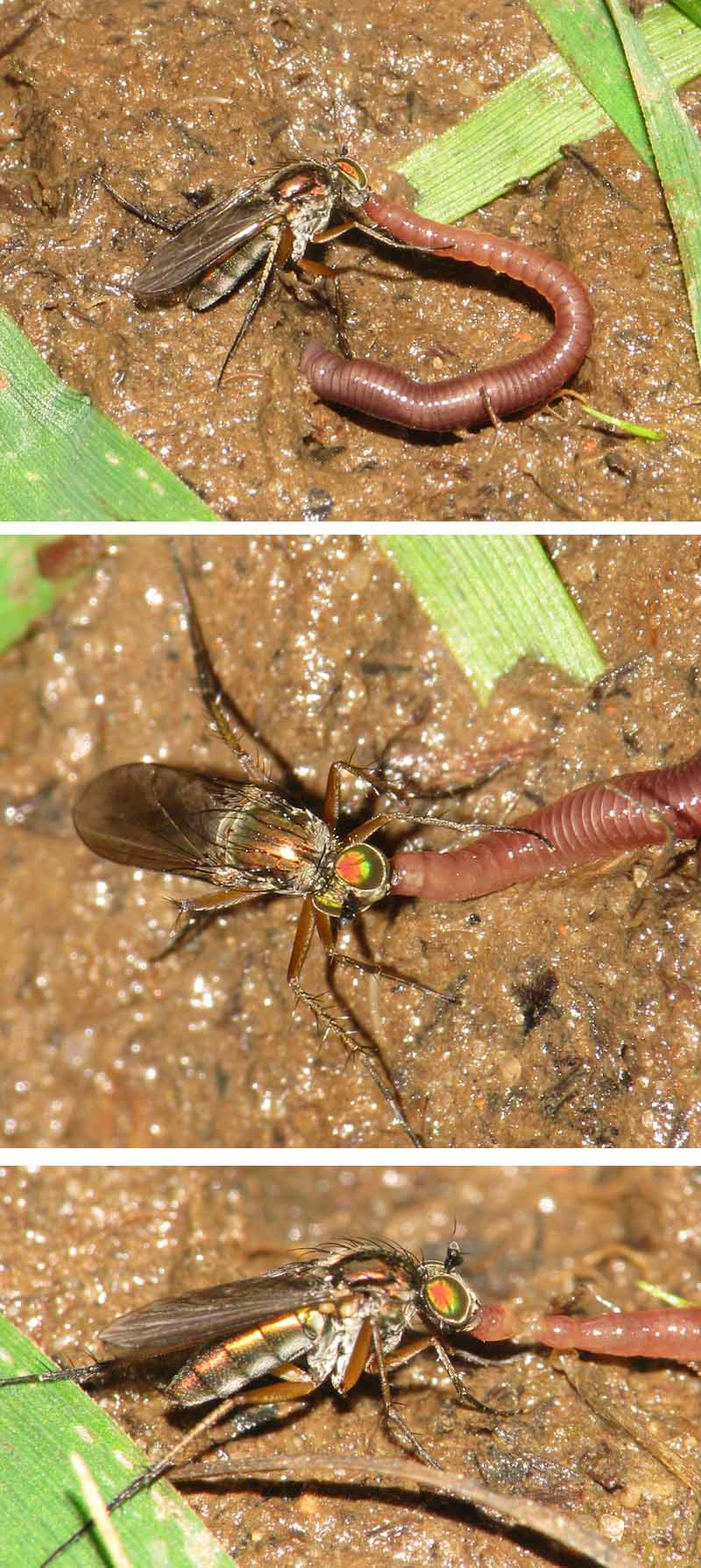 [182.69Kb] |
|
|
|
| Sundew |
Posted on 29-06-2014 23:15
|
|
Member Location: Berlin and Baden-Württemberg, Germany Posts: 3939 Joined: 28.07.07 |
Here the worm faces a double attack:
Sundew attached the following image: 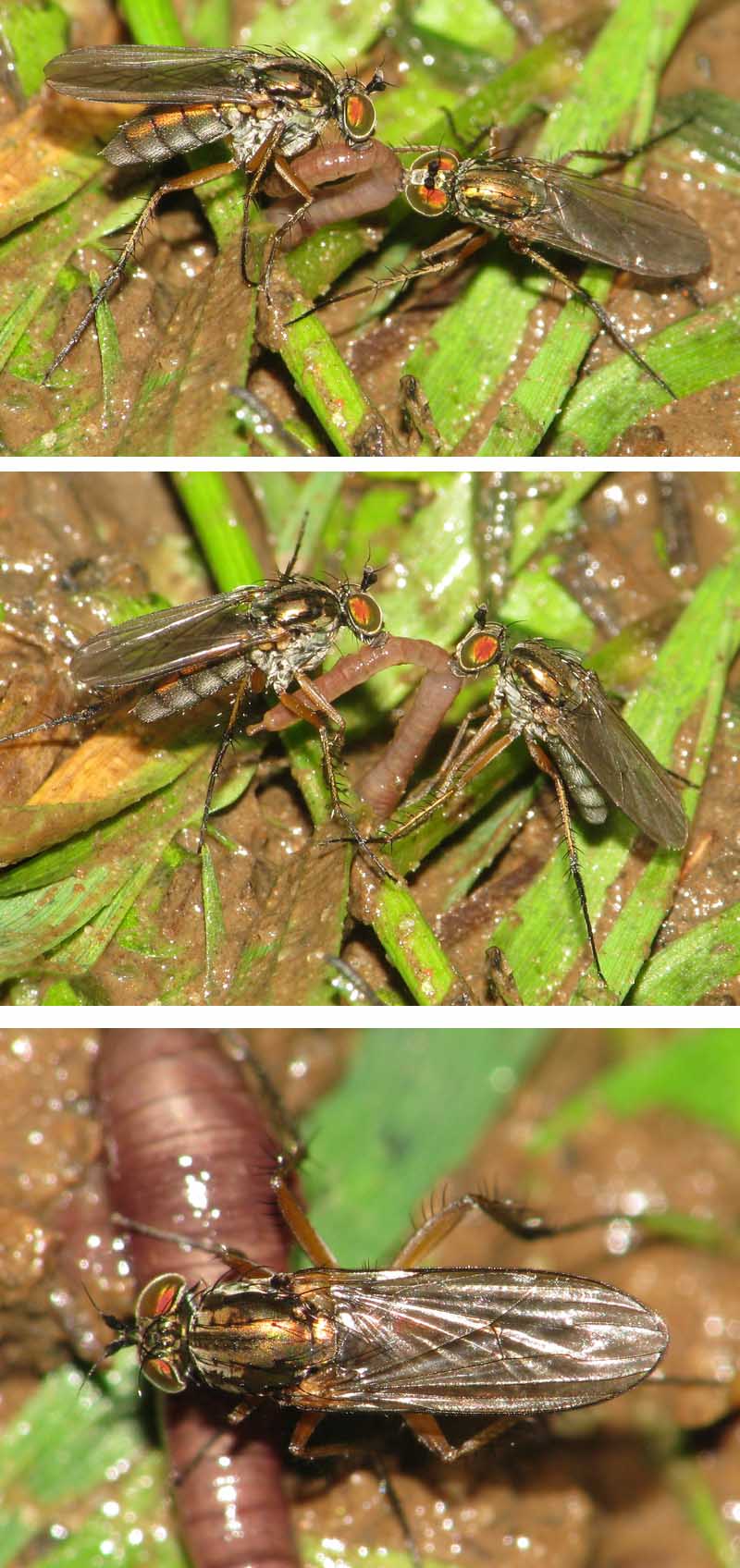 [171.07Kb] |
|
|
|
| Sundew |
Posted on 29-06-2014 23:16
|
|
Member Location: Berlin and Baden-Württemberg, Germany Posts: 3939 Joined: 28.07.07 |
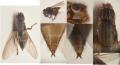
The hunter in detail:
Sundew attached the following image: 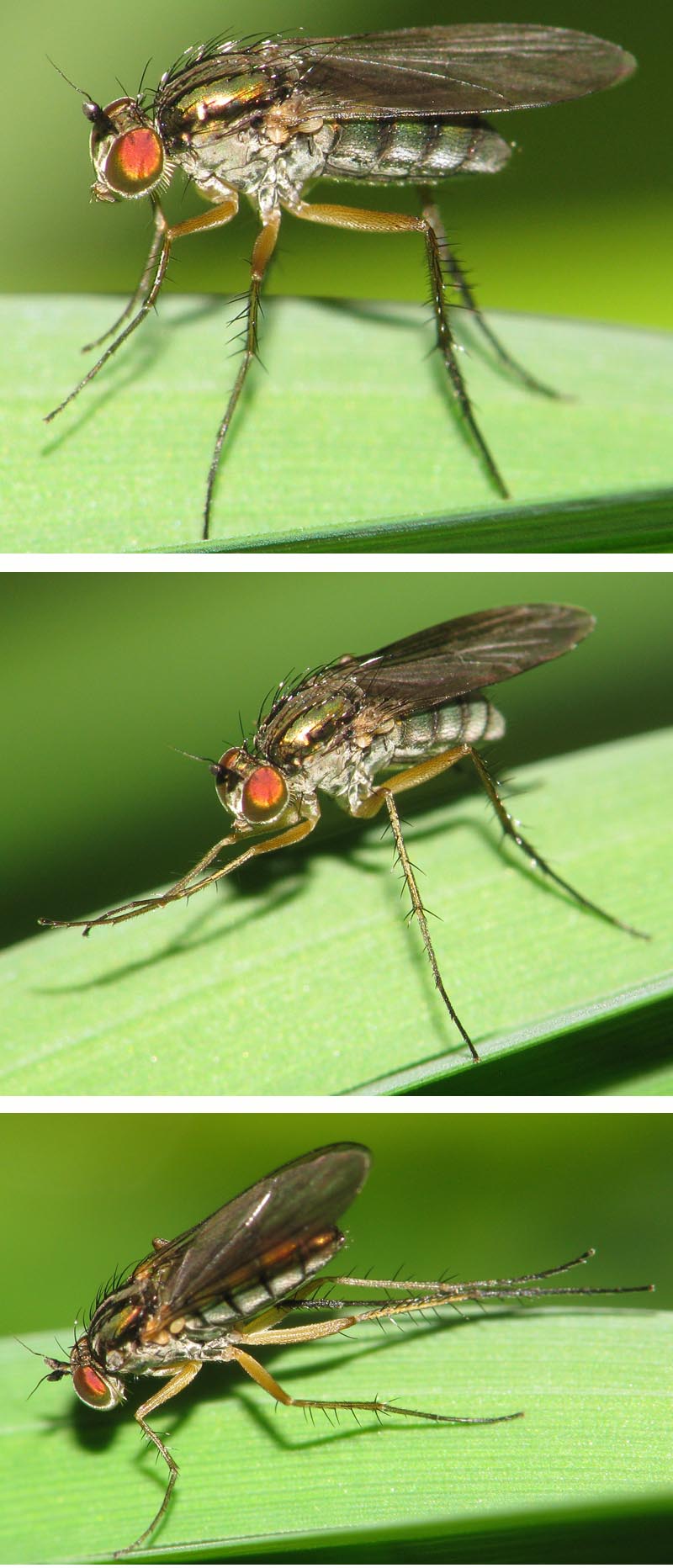 [176.14Kb] |
|
|
|
| ValerioW |
Posted on 29-06-2014 23:23
|
 Member Location: Padova - Italy Posts: 982 Joined: 01.06.12 |
Dolichopus sp. Wow, first class predators! Never thought they could prey on such a big animal! |
|
|
|
| John Carr |
Posted on 30-06-2014 02:03
|
 Super Administrator Location: Colorado, USA Posts: 10729 Joined: 22.10.10 |
Probably Dolichopus ungulatus. |
 |
|
| Igor Grichanov |
Posted on 30-06-2014 08:48
|
 Member Location: St.Petersburg, Russia Posts: 1835 Joined: 17.08.06 |
Dolichopus ungulatus except for the last 2 shots with different Dolichopus sp.
Igor Grichanov |
|
|
|
| Sundew |
Posted on 30-06-2014 12:15
|
|
Member Location: Berlin and Baden-Württemberg, Germany Posts: 3939 Joined: 28.07.07 |
Late, but not too late, I found Igor's Dolichopodidae key (http://www.dipter...Europe.pdf) and hope to get more autonomous using this great tool. Now I see that the worm-battling females have black lower postocular ciliae (leading to D. ungulatus), while the last series shows an animal with pale postocular ciliae (all three pics are the same individual). I tried the key and followed the path 1. mid basitarsus with at least one dorsal seta, 2. lower calypter with black ciliae, 3. antenna mostly brown black; at most scape yellow beneath, 4. both bends of M1+2 smoothly rounded and weakly formed. Thus I arrived at D. trivialis. Did I check the right characters, and do you agree with my ID? Thanks for any help in learning - the Dolis are such great flies, I am bound to reveal their secrets to myself! Regards, Sundew Sundew attached the following image: 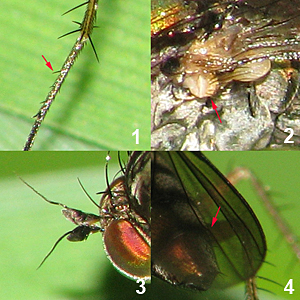 [151.39Kb] |
|
|
|
| Sundew |
Posted on 01-07-2014 08:12
|
|
Member Location: Berlin and Baden-Württemberg, Germany Posts: 3939 Joined: 28.07.07 |
A confirmation or correction would be fine... |
|
|
|
| Marc Pollet |
Posted on 26-11-2023 12:01
|
|
Member Location: Welle (Denderleeuw) Posts: 161 Joined: 02.06.05 |
Sundew wrote: Hi, Some weeks ago I watched a lot of Dolis, belonging to different taxa, on a wet forest track in southern Brandenburg. I was surprised that some of them hunted small earthworms. Though the worm finally made its escape, parts of it were bitten off by the flies. I read that Dolis prey on Enchytraeids (http://www.zfmk.d...0H12S5.PDF) but did not find any information about Lumbricids as prey. Can the flies be identified? I hope all the pictures show the same species, as there were so many flies around. Many thanks for help, Sundew |
|
|
|
| Marc Pollet |
Posted on 26-11-2023 12:02
|
|
Member Location: Welle (Denderleeuw) Posts: 161 Joined: 02.06.05 |
Dear Sundew, The attacking dolichopodids belong to Dolichopus ungulatus. Truly exciting observation that is not truly surprising to me. I have seen doli larvae attacking lumbricids as well. Cheers, Marc |
|
|
|
| Marc Pollet |
Posted on 26-11-2023 12:05
|
|
Member Location: Welle (Denderleeuw) Posts: 161 Joined: 02.06.05 |
Dear Sundew, The multiple specimens attacking the earthworm belong to D. ungulatus, but the single specimen you refer to as "the hunter" is another Dolichopus, D. trivialis as you found out yourself. Cheers, Marc (mpollet.doli@gmail.com - I add my email address as I do not often visit this forum, you see. I should visit it more, I know). |
|
|
|
| Jump to Forum: |