


Diptera.info :: Identification queries :: Diptera (adults)
 Tachinidae
|
|
| Susan R Walter |
Posted on 11-03-2007 00:08
|
 Member Location: Touraine du Sud, central France Posts: 1802 Joined: 14.01.06 |
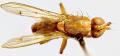
Please help with this one, found on my kitchen windowsill (Essex, south east England), autumn 2006. I have run it through Tschoring's key and come out at Macquartia dispar, but I am *extremely* dubious about it. I assume it is male, as the eyes meet at the top of the head. It appears to have a well developed post-scutellum; the eyes are hairy; tibiae reddish; the abdomen dusted in a tesselated pattern; wings are dusky; hairs on the back of the head black; 3 post-sutural ia; the arista is either bare or with very short hairs - I can't quite see well enough to make up my mind; R5 is narrowly open.
Susan R Walter attached the following image:  [173.98Kb] Susan |
 |
|
| Susan R Walter |
Posted on 11-03-2007 00:09
|
|
Member Location: Touraine du Sud, central France Posts: 1802 Joined: 14.01.06 |
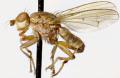
Another view.
Susan R Walter attached the following image: 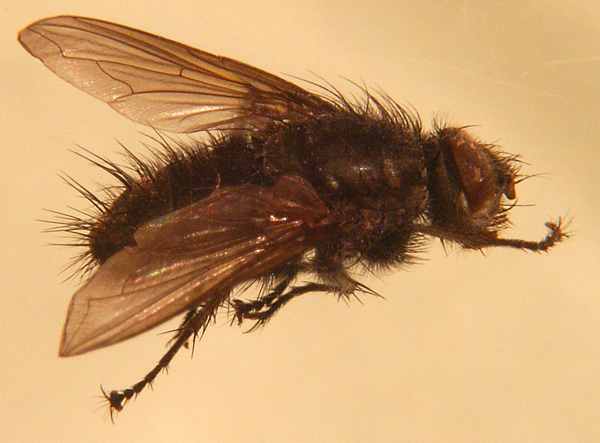 [172.83Kb] Susan |
|
|
|
| Zeegers |
Posted on 11-03-2007 11:05
|
|
Member Location: Soest, NL Posts: 19317 Joined: 21.07.04 |
Hi Susan, Difficult to tell. If the hairs on the back on the head are all really black/dark, and if the eyes are nearly meeting on the vertex, it is more than likely that you actually have a male Macquartia. In which case dispar agrees with your description of the tessellate abdomen. SO, you just might be right ! Theo |
|
|
|
| Susan R Walter |
Posted on 11-03-2007 13:52
|
|
Member Location: Touraine du Sud, central France Posts: 1802 Joined: 14.01.06 |
Good heavens! What a nice surprise - I was convinced it was going to turn out to be nothing like Macquartia. I have checked really carefully and the hairs on the back of the head are indeed all black. For all intents and purposes the eyes touch just under the ocellular triangle. I don't think there is even room for a pair of bristles there. This Tachinid malarky is obviously easier than I thought (don't worry - that will ensure that I get the next 6 really embarrassingly wrong  ) )Many thanks Theo once again. Forgot to mention - the specimen is 10mm. Edited by Susan R Walter on 11-03-2007 14:03 Susan |
|
|
|
| Zeegers |
Posted on 11-03-2007 14:53
|
|
Member Location: Soest, NL Posts: 19317 Joined: 21.07.04 |
Once you know what to look for: all hairs on occiput black is quite uncommon for Tachinidae and mostly restricted to Tachininae (as always: there are exceptions). If there are just a few light hairs, these will show at the lower end of the occiput, so at the level of the lower eye margin in lateral view. This ID sounds OK. Theo |
|
|
|
| ChrisR |
Posted on 12-03-2007 12:16
|
 Super Administrator Location: Reading, England Posts: 7706 Joined: 12.07.04 |
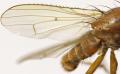
Hmm, is it just the angle of the photo of is the vein m-cu really strongly angled? I think if we could see more surface detail it would help - less of a silhouette  |
|
|
|
| Susan R Walter |
Posted on 12-03-2007 13:58
|
|
Member Location: Touraine du Sud, central France Posts: 1802 Joined: 14.01.06 |
Chris - don't you go bursting my bubble now  I know the question in the key about the strongly angled m-cu. I'll go back and check against Tschoring's drawings just to make sure. I'll try and take some more photos, but after tonight I'll have access to the fly but not the camera for a week. I'm sorry the photos are so rubbish - taken at the end of a long session of photographing specimens and getting lazy about adjusting the lights etc. It doesn't help that this is a very dark and hairy fly. I know the question in the key about the strongly angled m-cu. I'll go back and check against Tschoring's drawings just to make sure. I'll try and take some more photos, but after tonight I'll have access to the fly but not the camera for a week. I'm sorry the photos are so rubbish - taken at the end of a long session of photographing specimens and getting lazy about adjusting the lights etc. It doesn't help that this is a very dark and hairy fly.
Susan |
|
|
|
| Zeegers |
Posted on 12-03-2007 14:05
|
|
Member Location: Soest, NL Posts: 19317 Joined: 21.07.04 |
Chris, you are thinking Voriini ? Voriini have all hairs on occiput white. Moreover, no british Voriini has the eyes on vertex nearly touching. Sarah, bubble back again, the crossvein m-cu is not oblique enough. My bet is still on Macquartia. Theo |
|
|
|
| Jump to Forum: |