


Diptera.info :: Identification queries :: Diptera (adults)
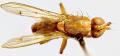
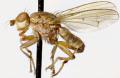
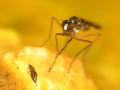
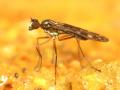
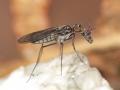
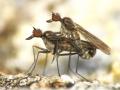
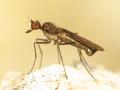
 Dolichopodidae USA 2011-VI-6 (= Gymnopternus cf. opacus)
|
|
| John Carr |
Posted on 07-06-2011 02:43
|
 Super Administrator Location: Colorado, USA Posts: 10655 Joined: 22.10.10 |
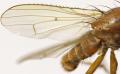
Massachusetts, USA June 6 2011, on a leaf. 3 mm long. I got different results with the keys from Robison and Vockeroth 1981 (MND) and Bickel 2009 (MCAD). Does the lack of strong bristles on the fore tibiae rule out Dolichopodinae? There is a comb of short hairs. Click pictures for larger size on Flickr.      Front tibia has a comb but no long hairs (photo) Edited by John Carr on 03-12-2011 20:41 |
 |
|
| Stefan Naglis |
Posted on 07-06-2011 07:15
|
|
Member Location: Switzerland Posts: 738 Joined: 27.12.08 |
Hercsotomus or Gymnopternus |
|
|
|
| John Carr |
Posted on 07-06-2011 11:44
|
|
Super Administrator Location: Colorado, USA Posts: 10655 Joined: 22.10.10 |
The key says Gymnopternus has hairs near the posterior spiracle. I don't see hairs but I'm not sure where the posterior spiracle is on this fly. |
|
|
|
| Stefan Naglis |
Posted on 07-06-2011 15:39
|
|
Member Location: Switzerland Posts: 738 Joined: 27.12.08 |
If the pleura ist bare in front of the posterior spiracle, it is Hercostomus. |
|
|
|
| Marc Pollet |
Posted on 18-06-2011 09:18
|
|
Member Location: Welle (Denderleeuw) Posts: 161 Joined: 02.06.05 |
It's definitely Gymnopternus, considering the structure of the hypopygium (also the shape of the cercus), and the parallel course of veins R4+5 and M1+2. The "clutch" of setae in front of the posterior spiracle are sometimes very hard to observe and sometimes only encompass three or four setae, but I am 100% sure that you'll find them eventually in this species. Cheers, Marc Dr Marc Pollet mpollet.doli@gmail.com |
|
|
|
| John Carr |
Posted on 02-12-2011 02:01
|
|
Super Administrator Location: Colorado, USA Posts: 10655 Joined: 22.10.10 |
I'm trying to run this through a regional key and I have a really basic question: what are the "hypopygial lamellae"? I only know terminology for Nematocera, and that term is not used. If I am in the right couplet they could be "opaque brown or black, not long-triangular" or "mostly pale or translucent, if brownish then elongate and triangular." |
|
|
|
| Igor Grichanov |
Posted on 02-12-2011 09:44
|
 Member Location: St.Petersburg, Russia Posts: 1818 Joined: 17.08.06 |
"hypopygial lamellae" in old keys = cerci
Igor Grichanov |
|
|
|
| John Carr |
Posted on 03-12-2011 02:26
|
|
Super Administrator Location: Colorado, USA Posts: 10655 Joined: 22.10.10 |
Thank you. Now I can call this fly unidentifiable due to my failure or a bad key, rather than due to my ignorance. The key to Gymnopternus works for me about as well as the key to North American Platypalpus, which is to say not at all. |
|
|
|
| Stefan Naglis |
Posted on 03-12-2011 15:02
|
|
Member Location: Switzerland Posts: 738 Joined: 27.12.08 |
Hello John, which key have you used? |
|
|
|
| John Carr |
Posted on 03-12-2011 15:34
|
|
Super Administrator Location: Colorado, USA Posts: 10655 Joined: 22.10.10 |
I am using Robinson, H. 1964. A synopsis of the Dolichopodidae of the southeastern United States and adjacent regions. Miscellaneous publications of the Entomological Society of America 4:103-192. Mine resembles G. frequens Loew but differs in color characters that are considered of specific importance and the shape of the cerci is not quite right. |
|
|
|
| Stefan Naglis |
Posted on 03-12-2011 18:43
|
|
Member Location: Switzerland Posts: 738 Joined: 27.12.08 |
Hello John, Robinson’s 1964 key includes not all North American species. When I use the key, I end at Gymnopternus opacus Loew. In couplet 28, I regard the hypopygial lamellae as more pale than brown or black. Best wishes, Stefan |
|
|
|
| John Carr |
Posted on 03-12-2011 20:38
|
|
Super Administrator Location: Colorado, USA Posts: 10655 Joined: 22.10.10 |
There are a few cases, like that one, where the language makes more sense to an expert. Also when parts are described as long or short or large or small. I live in the region covered by Robinson's key. I figured a Loew species was likely and looked at that couplet, but assumed "hypopygial lamellae small, without a basal lobe or prominent setae" excluded my fly. I would have said they were large and with prominent setae, and shaped a bit differently from Robinson's figure 97. The photo of the type at MCZ does not show them. It does show almost uniformly pale antennae. Do antennae turn pale after 150 years? |
|
|
|
| Jump to Forum: |