


Diptera.info :: Identification queries :: Diptera (adults)
Who is here? 1 guest(s)
 Hybomitra ciureai
|
|
| Jan Wind |
Posted on 27-05-2011 22:50
|
|
Member Location: Ede, The Netherlands Posts: 809 Joined: 24.10.10 |
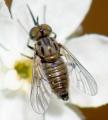
Seen on 20 may 2011 in agricultural grasslands area border with Poplar -Willow and reedlands. Is this possibly Hybomitra lundbecki??
Jan Wind attached the following image: 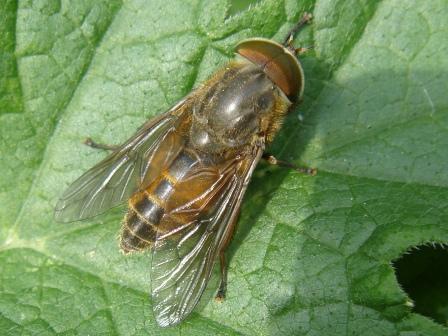 [47.22Kb] Edited by Jan Wind on 29-05-2011 11:40 |
 |
|
| Jan Wind |
Posted on 27-05-2011 22:51
|
|
Member Location: Ede, The Netherlands Posts: 809 Joined: 24.10.10 |
pics 2
Jan Wind attached the following image: 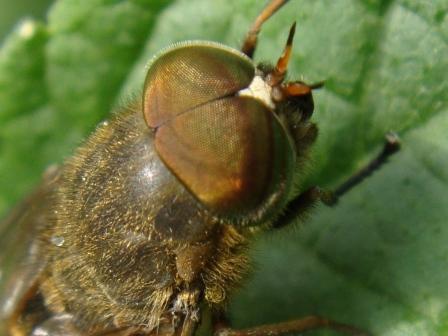 [38.8Kb] |
|
|
|
| Jan Wind |
Posted on 27-05-2011 22:51
|
|
Member Location: Ede, The Netherlands Posts: 809 Joined: 24.10.10 |
pics 3
Jan Wind attached the following image: 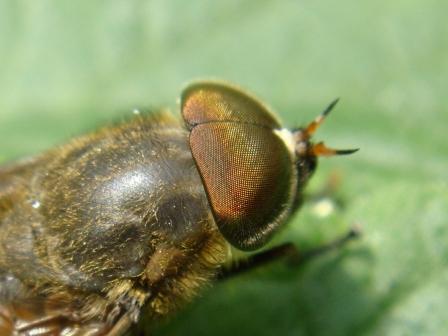 [35.6Kb] |
|
|
|
| libor |
Posted on 28-05-2011 16:06
|
|
Member Location: western Bohemia Posts: 1301 Joined: 30.05.09 |
How long are hairs on 1st antennal segment? As long as antennal segments 1+2 or very short? Libor |
|
|
|
| Jan Wind |
Posted on 28-05-2011 19:00
|
|
Member Location: Ede, The Netherlands Posts: 809 Joined: 24.10.10 |
They are about as long as antenne segments 1+2. |
|
|
|
| libor |
Posted on 28-05-2011 19:24
|
|
Member Location: western Bohemia Posts: 1301 Joined: 30.05.09 |
So, I see only two possibilities: Upper facets strongly enlarged, clearly separated from lower smaller facets, 1st antennal segment yellowich to yellow-brownish = H. ciureai. Upper facets not sharply separated = H. muehlfeldi. (I have not male ciureai in my collection, so I cannot compare...). Libor |
|
|
|
| Jan Wind |
Posted on 28-05-2011 19:44
|
|
Member Location: Ede, The Netherlands Posts: 809 Joined: 24.10.10 |
I donot see a sharp division between larger and smaller facets only gradual differences after checking all pictures in the series I made. But my pictures are not showing sufficiently the frontside. Hybomitra muehlfeldi is called here the "peat" hybomitra. The area I located it is a rather moist heavyclay area. Does this mean that muehlfeldi is rather unlikely? and ciureai more likely? Edited by Jan Wind on 28-05-2011 20:05 |
|
|
|
| libor |
Posted on 28-05-2011 20:06
|
|
Member Location: western Bohemia Posts: 1301 Joined: 30.05.09 |
I do not know situation in the Netherlands, but in CZE H. muehlfeldi prefers surroundings of ponds,but I have it from forests, etc. It dislikes dry habitats. But remember, please, that many info to habitat preferences are considering larvae developping. Adults have wings :-) Libor |
|
|
|
| Jan Wind |
Posted on 28-05-2011 20:19
|
|
Member Location: Ede, The Netherlands Posts: 809 Joined: 24.10.10 |
There is a large pond nearby. I take your point about larvae and adults. |
|
|
|
| Zeegers |
Posted on 29-05-2011 09:19
|
|
Member Location: Soest, NL Posts: 19310 Joined: 21.07.04 |
It is clearly ciureai. That is a remarkably early record ! Theo |
|
|
|
| Zeegers |
Posted on 29-05-2011 09:20
|
|
Member Location: Soest, NL Posts: 19310 Joined: 21.07.04 |
Jan, could you please post the locality of this picture ? Thanks Theo |
|
|
|
| Jan Wind |
Posted on 29-05-2011 11:06
|
|
Member Location: Ede, The Netherlands Posts: 809 Joined: 24.10.10 |
Thank you both Libor and Theo for the interesting information. The location is De Regulieren, Buurmalsen in the Betuwe The Netherlands.
Edited by Jan Wind on 29-05-2011 11:08 |
|
|
|
| Jump to Forum: |