

Diptera.info :: Family forums :: Asilidae Forum
Who is here? 1 guest(s)
 Rhadiurgus?
|
|
| Quaedfliegh |
Posted on 20-08-2010 18:46
|
 Member Location: Tilburg Netherlands Posts: 2225 Joined: 18.05.10 |
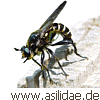
Found this picture on Dutch site and was listed as Neoitamus cyanurus which it certainly is not. At first sight the obvious genus would be Tolmerus...... But the genital is bothering me  Shape reminds me very much of Rhadiurgus and not Tolmerus. Shape reminds me very much of Rhadiurgus and not Tolmerus. Probably the problem will not be solved but is there anyone with a helpfull suggestion? I want to certain even when that means uncertain!  Picture used with permission of owner. Quaedfliegh attached the following image: 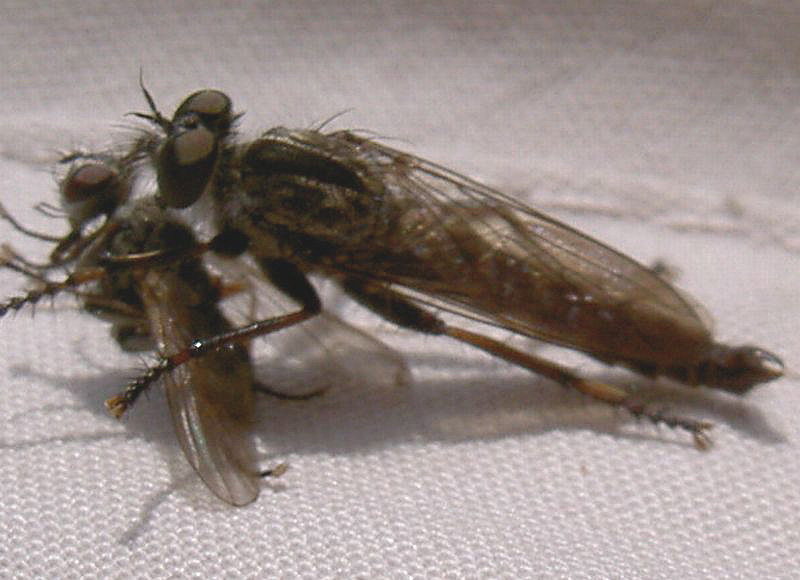 [122Kb] Edited by Quaedfliegh on 20-08-2010 18:50 Greetings, Reinoud Field guide to the robber flies of the Netherlands and Belgium: https://www.jeugdbondsuitgeverij.nl/product/field-guide-to-the-robberflies-of-the-netherlands-and-belgium/ https://www.nev.nl/diptera/ |
 |
|
| Danny Wolff |
Posted on 20-08-2010 21:56
|
 Member Location: Germany Posts: 329 Joined: 27.05.04 |
Leptogaster wrote: Probably the problem will not be solved ... Hi, with this statement you are quite right. All in all the characters remind me most of Tolmerus, even the genital. Why do you think it is not a Tolmerus, for example T. atricapillus? In my opinion the quality of the picture is too bad to exclude Tolmerus. Greetings, Danny |
|
|
|
| Quaedfliegh |
Posted on 20-08-2010 23:51
|
|
Member Location: Tilburg Netherlands Posts: 2225 Joined: 18.05.10 |
Hello Danny, I'm trying to gain experience in the more subtle diffrences between species and yes the quality isn't too good of the picture. I really appreciate your opinion and will accept any verdict! I can't see an extension of sternite 8 that is why i excluded T. atricapillus. The more hooked shape and the fact that the background is clearly visible through the upper clasper- (epandrium), so it is thin and made me wonder. I cant find any picture of a Tolemerus where you get such a clear look through. The only 2 other species with a similar thin epandrium i've got experience with are Philonicus albiceps (obviously not this creature) and Rhadiurgus and that's why i asked. I got several collected males of M. atricapillus and even in a dried state it is hard to look through + they all have the extension on sternite 8. Am i seeing ghosts in a vague picture?  probably, but i've got to learn! Again i really value your opinion Danny. probably, but i've got to learn! Again i really value your opinion Danny.PS Danny, could you have a look at this picture as well? http://waarnemingen.be/waarneming/view/43636978?_popup=1 Greetings, Reinoud Field guide to the robber flies of the Netherlands and Belgium: https://www.jeugdbondsuitgeverij.nl/product/field-guide-to-the-robberflies-of-the-netherlands-and-belgium/ https://www.nev.nl/diptera/ |
|
|
|
| Danny Wolff |
Posted on 22-08-2010 22:01
|
|
Member Location: Germany Posts: 329 Joined: 27.05.04 |
Hi Reinoud, Leptogaster wrote: I can't see an extension of sternite 8 that is why i excluded T. atricapillus. The more hooked shape and the fact that the background is clearly visible through the upper clasper- (epandrium), so it is thin and made me wonder. ... I got several collected males of M. atricapillus and even in a dried state it is hard to look through + they all have the extension on sternite 8. I can't see any extension on sternitze 8, too, and you are right, if it is T. atricapillus, there would be. But in this view angle I'm not sure that the extension would be to see even it is there. I can't see the "tooth" on the epandrium, which has to be there if it is Rhadiurgus. The arista is not quite Rhadiurgus-like and the upper surface of the face knob seems to be completely dusted and not partly shining as it would be expected to in Rhadiurgus. All in all, the picture is too bad for an ID and I think it is time waste to try any further ID. One thing is clear, it's no Neoitamus cyanurus as you have mentioned first. Greetings, Danny |
|
|
|
| Quaedfliegh |
Posted on 22-08-2010 23:45
|
|
Member Location: Tilburg Netherlands Posts: 2225 Joined: 18.05.10 |
Thank you very much Danny!
Greetings, Reinoud Field guide to the robber flies of the Netherlands and Belgium: https://www.jeugdbondsuitgeverij.nl/product/field-guide-to-the-robberflies-of-the-netherlands-and-belgium/ https://www.nev.nl/diptera/ |
|
|
|
| Jump to Forum: |