


Diptera.info :: Identification queries :: Diptera (adults)
Who is here? 1 guest(s)
 Tachinid from Peruvian Amazon ID?
|
|
| pbertner |
Posted on 20-07-2010 01:07
|
|
Member Location: Posts: 121 Joined: 01.07.10 |
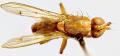
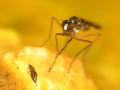
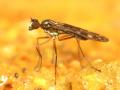
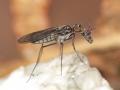
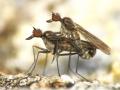
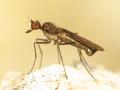
From Manu national park, Amazonian lowlands Thanks for any help! Paul Edited by pbertner on 21-07-2010 21:31 Portfolio - https://rainfores...ugmug.com/ http://www.flickr...37609@N08/ blog photo companion http://pbertner.w... |
|
|
|
| jorgemotalmeida |
Posted on 20-07-2010 18:28
|
 Member Location: Viseu - PORTUGAL Posts: 9296 Joined: 05.06.06 |
Tachinidae. |
 |
|
| Stephane Lebrun |
Posted on 20-07-2010 18:35
|
 Member Location: Le Havre, France Posts: 8248 Joined: 03.03.07 |
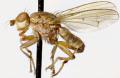
The hypopleural bristles are well visible, that rules Muscoidea out.
Stephane. |
|
|
|
| ChrisR |
Posted on 20-07-2010 18:41
|
 Super Administrator Location: Reading, England Posts: 7706 Joined: 12.07.04 |
Yes, I'd go for a tachinid too - I have seen similar in samples but heaven knows what they are  There seems to be a complex of species around that colour pattern. There seems to be a complex of species around that colour pattern.As a guide it is clearly a calyptrate fly (house-fly type), the median vein is bent (typical of tachinids but not conclusive for any family), hypopleurals strong and strong bristles present ... so favours tachinids. It doesn't look like an anthomyid or rhinophorid or calliphorid or sarcophagid ... so again it must be a tachinid!
Edited by ChrisR on 20-07-2010 18:44 Manager of the UK Species Inventory in the Angela Marmont Centre for UK Biodiversity at the Natural History Museum, London. |
|
|
|
| jorgemotalmeida |
Posted on 20-07-2010 19:17
|
|
Member Location: Viseu - PORTUGAL Posts: 9296 Joined: 05.06.06 |
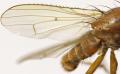
ChrisR wrote: Yes, I'd go for a tachinid too - I have seen similar in samples but heaven knows what they are There seems to be a complex of species around that colour pattern.As a guide it is clearly a calyptrate fly (house-fly type), the median vein is bent (typical of tachinids but not conclusive for any family), hypopleurals strong and strong bristles present ... so favours tachinids. It doesn't look like an anthomyid or rhinophorid or calliphorid or sarcophagid ... so again it must be a tachinid! Attached I point out the place of HYPOPLEURAL bristles = Meral bristles, and the M vein with a strong bent to the wing margin. I must add that MERAL bristles can EXIST in Muscids! But they are not well developed. Exceptions belonging to this are Eginia which it has strong meral bristles (not sure if there is in Peru...), and probably there will be much more in Peru.  The presence of a strong and convex subscutellum points us to Tachinidae. Not visible in this photo. jorgemotalmeida attached the following image: 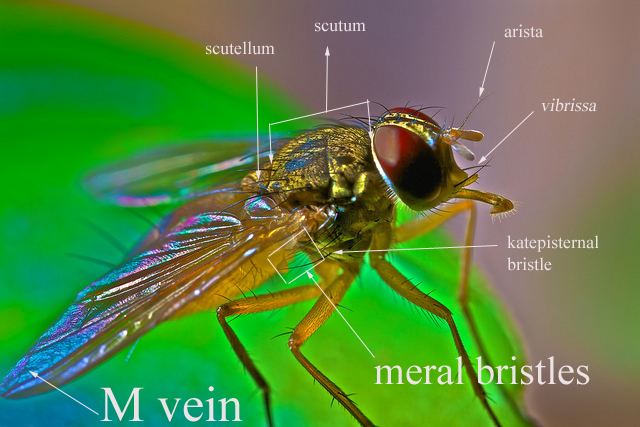 [187.45Kb] Edited by jorgemotalmeida on 20-07-2010 19:40 |
|
|
|
| Stephane Lebrun |
Posted on 20-07-2010 19:43
|
|
Member Location: Le Havre, France Posts: 8248 Joined: 03.03.07 |
When there are some bristles on meron for Muscidae (Eginiini indeed), they are well less developped than here and never arranged in a row like this. Others Muscidae can have some miscroscopic hairs on meron.
Stephane. |
|
|
|
| jorgemotalmeida |
Posted on 20-07-2010 20:00
|
|
Member Location: Viseu - PORTUGAL Posts: 9296 Joined: 05.06.06 |
yeah, right, Stéphane. |
|
|
|
| pbertner |
Posted on 21-07-2010 21:37
|
|
Member Location: Posts: 121 Joined: 01.07.10 |
Thank you very much for the replies everyone, very informative as always! Paul Portfolio - https://rainfores...ugmug.com/ http://www.flickr...37609@N08/ blog photo companion http://pbertner.w... |
|
|
|
| Jump to Forum: |