


Diptera.info :: Identification queries :: Diptera (adults)
 Coenosia > C. infantula (= testacea??)
|
|
| Stephen R |
Posted on 28-05-2010 23:09
|
 Member Location: Clitheroe Lancashire UK Posts: 2396 Joined: 12.06.09 |
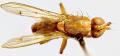
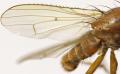
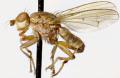
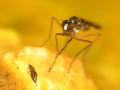
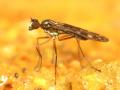
3+mm, 28 May 2010, Clitheroe England. The key (Gregor et al) takes me to C. infantula, and my fly fits the description in all regards except that the gena is much wider than the flagellomere, and the book is quite clear that it shouldn't be. Also, infantula should have 'section of M1 vein between crossveins shorter than apical section of CuA1', whereas on mine they seem more or less equal. Have I made a mistake, or does my specimen belong to a species that occurs in Britain but not in Central Europe? Stephen R attached the following image: 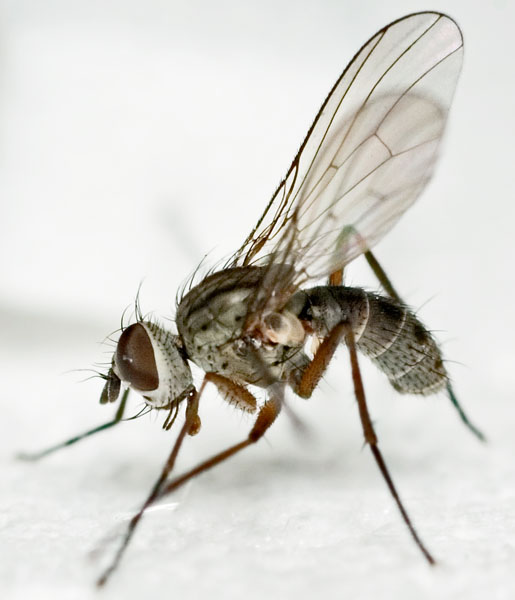 [80.14Kb] Edited by Stephen R on 18-07-2010 15:45 |
|
|
|
| Stephane Lebrun |
Posted on 29-05-2010 11:11
|
 Member Location: Le Havre, France Posts: 8248 Joined: 03.03.07 |
I agree it is not C. infantula. To tell more I 'll need the fly itself (Coenosia is a difficult genus even with the fly under lens, so I let you imagine from a unique picture). Send it to me if you want. Stephane. |
|
|
|
| Stephen R |
Posted on 29-05-2010 11:46
|
|
Member Location: Clitheroe Lancashire UK Posts: 2396 Joined: 12.06.09 |
Thanks Stephane, I'll contact you directly. Stephen. |
|
|
|
| Stephane Lebrun |
Posted on 18-07-2010 13:12
|
|
Member Location: Le Havre, France Posts: 8248 Joined: 03.03.07 |
I have had the fly under lens and came to the conclusion that Coenosia infantula is the most probable ID. The frons which is black till the anterior edge, the black palpi, the dark base of abdomen and the shape of abdomen rule out C. testacea. I have ruled out C. nigridigitata and C. rufipalpis because the chaetotaxy of the 2 posterior pairs of femora didn't match. As I told to Stephen, I am bothered by the genae height (they are somewhat higher than the width of 3d ant. and should be narrower). I don't intend to examin the genitalia because they are quite similar between the two species, and thus it won't be helpful. I have seen many other doubtful cases between C. infantula and C. testacea like females which have an anterior part of frons orange but genae not especially higher than 3d ant. segment (this is the case with the females sent by Stephen also). Any feedback from Coenosia experts is of course welcome.
Stephane. |
|
|
|
| Nikita Vikhrev |
Posted on 18-07-2010 14:52
|
 Member Location: Moscow, Russia Posts: 9555 Joined: 24.05.05 |
Stephane, I also have doubts in validity of infantula. One day we/you/I should to take together a large mterial and solve this problem. So far, one can try to separate these to species or label any specimens by lder name, which is testacea in this case. Nikita Vikhrev - Zool Museum of Moscow University |
|
|
|
| Stephen R |
Posted on 18-07-2010 15:41
|
|
Member Location: Clitheroe Lancashire UK Posts: 2396 Joined: 12.06.09 |
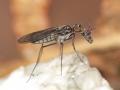
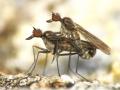
Thank you both for your help in this. I have collected more specimens from this place (all within one or two metres). In addition to this male and the female I sent to Stephane, I have three males which go to C. testacea and two females which seem more intermediate. Gena height and reddening of the front margin of the frontal vitta are variable, both being on average greater in the males. The basal yellowing of the abdomen varies in the males, and this dark one could well be towards one end of a continuous spectrum. The females share extensive darkening of the front femur, and the frontal vitta is slightly pale at the front but not as red as in some of the males. It would make a lot of sense if all these individuals were members of the same variable species. I would be happy to donate my specimens to whoever decides to take the question further. Stephen  |
|
|
|
| Stephane Lebrun |
Posted on 18-07-2010 20:44
|
|
Member Location: Le Havre, France Posts: 8248 Joined: 03.03.07 |
Nikita Vikhrev wrote: Stephane, I also have doubts in validity of infantula. Thank you Nikita, I am happy to heard this. I'll keep all material from now. My own material (not numerous) is more or less doubtful and it reassures me to know that I'm not the only one in this case. Stephane. |
|
|
|
| Jump to Forum: |