



Diptera.info :: Identification queries :: Diptera (adults)
 Conops vesicularis (was Conopid - Physocephala?)
|
|
| ChrisR |
Posted on 16-05-2009 20:18
|
 Super Administrator Location: Reading, England Posts: 7706 Joined: 12.07.04 |
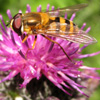
Is this nice conopid a Physocephala sp.?  Seen in southern England today Seen in southern England today
ChrisR attached the following image: 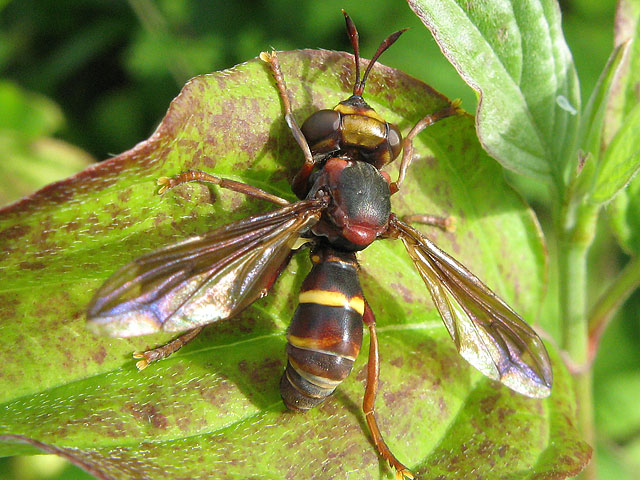 [106.87Kb] Edited by ChrisR on 07-06-2009 20:29 Manager of the UK Species Inventory in the Angela Marmont Centre for UK Biodiversity at the Natural History Museum, London. |
 |
|
| phil withers |
Posted on 16-05-2009 23:32
|
|
Member Location: Lyon, France Posts: 521 Joined: 04.03.08 |
No, I think this is Conops vesicularis |
|
|
|
| ChrisR |
Posted on 16-05-2009 23:39
|
|
Super Administrator Location: Reading, England Posts: 7706 Joined: 12.07.04 |
Googling around, it does look like that could be the one ... a new species for me and it looked really unusual - being such a large, brown wasp mimic. Do you know its status in the UK? Is it unusual?
Manager of the UK Species Inventory in the Angela Marmont Centre for UK Biodiversity at the Natural History Museum, London. |
|
|
|
| phil withers |
Posted on 18-05-2009 12:09
|
|
Member Location: Lyon, France Posts: 521 Joined: 04.03.08 |
It is certainly striking, being so unlike the Conops-style one is used to that at first galnce I think one tends to ignore it as a wasp. Ken Smith said it was rare in England - I only ever caught one, but I think it is a lot earlier than the others, which might account for it. |
|
|
|
| ChrisR |
Posted on 18-05-2009 12:51
|
|
Super Administrator Location: Reading, England Posts: 7706 Joined: 12.07.04 |
Thanks Phil It was certainly striking and very docile too ... I had tried to catch it in a net but failed, just prior to taking this photo. I slapped the net on top and it just fell off the leaf ... next time I walked past the bush it was back on a leaf again sunning itself! I guessed it was going to be distinctive enough to identify from a photo so decided to leave it in peace
Manager of the UK Species Inventory in the Angela Marmont Centre for UK Biodiversity at the Natural History Museum, London. |
|
|
|
| conopid |
Posted on 08-06-2009 08:31
|
 Member Location: United Kingdom Posts: 1039 Joined: 02.07.04 |
Hi Chris, I have searched for Conopidae for 25 years and last year I saw my first C vesicularis. Then incredibly, this year I saw three in one day at three separate locations, then a fourth one at a later date elsewhere! It is certainly rightly regarded as a scarce fly in the UK, but maybe it has enjoyed a bit of a surge in numbers this year? Nigel Jones, Shrewsbury, United Kingdom |
|
|
|
| ChrisR |
Posted on 08-06-2009 09:43
|
|
Super Administrator Location: Reading, England Posts: 7706 Joined: 12.07.04 |
Well, this was definitely the first I have ever seen - it was quite striking. Last year I also bumped into 2 unusual species that seem to have been doing well recently - Stratiomys potamida and Mallota cimbiciformis. Also, many of the phasiine tachinids, like Cistogaster have been expanding their ranges It's not all good news though - we still have about 90 tachinids on our list with only 1 or 0 records ... many of which used to be commoner in the past (ie. we see them in collections but hardly ever get modern records for them). Manager of the UK Species Inventory in the Angela Marmont Centre for UK Biodiversity at the Natural History Museum, London. |
|
|
|
| phil withers |
Posted on 08-06-2009 14:04
|
|
Member Location: Lyon, France Posts: 521 Joined: 04.03.08 |
Regarding the loss of tachinids: are the hosts (where known) also decreasing in range ? |
|
|
|
| ChrisR |
Posted on 08-06-2009 19:30
|
|
Super Administrator Location: Reading, England Posts: 7706 Joined: 12.07.04 |
Not really sure - very little is known about the rarer species. But most tachinids are not very host-specific so I would guess that there should be suitable hosts ... but perhaps not a suitable climate or habitat
Manager of the UK Species Inventory in the Angela Marmont Centre for UK Biodiversity at the Natural History Museum, London. |
|
|
|
| Jump to Forum: |