


Diptera.info :: Identification queries :: Diptera (adults)
 four Tephritids
|
|
| Sundew |
Posted on 27-07-2008 22:41
|
 Member Location: Berlin and Baden-Württemberg, Germany Posts: 3939 Joined: 28.07.07 |
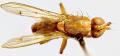
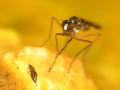
Hi, In the last days I saw several Tephritids - some I suppose to know, some not. So here are four of them: This one I think is Chaetorellia jaceae. Many of them mate on Centaurea stoebe. Sundew attached the following image: 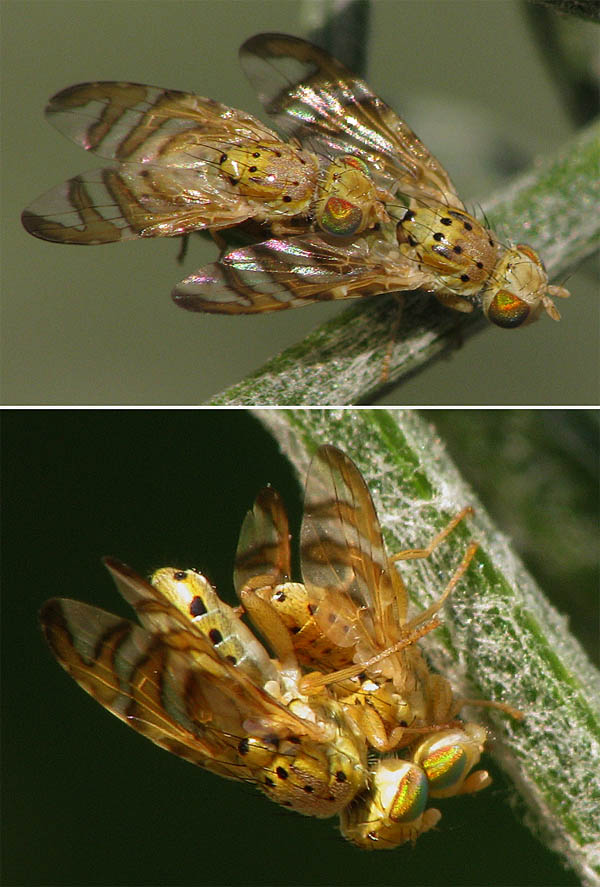 [105.62Kb] Edited by Sundew on 28-07-2008 00:16 |
|
|
|
| Sundew |
Posted on 27-07-2008 22:43
|
|
Member Location: Berlin and Baden-Württemberg, Germany Posts: 3939 Joined: 28.07.07 |
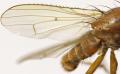
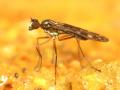
The next one should be Urophora quadrifasciata, also seen on Centaurea and Cirsium arvense.
Sundew attached the following image: 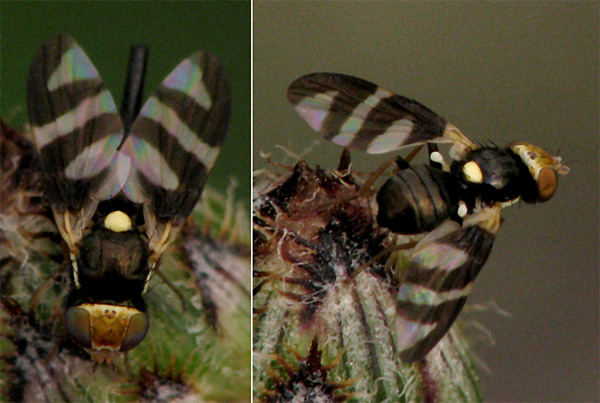 [119.1Kb] |
|
|
|
| Sundew |
Posted on 27-07-2008 22:44
|
|
Member Location: Berlin and Baden-Württemberg, Germany Posts: 3939 Joined: 28.07.07 |
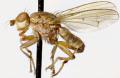
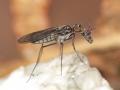
The next, seen today in our arboretum, is perhaps a Terellia?
Sundew attached the following image: 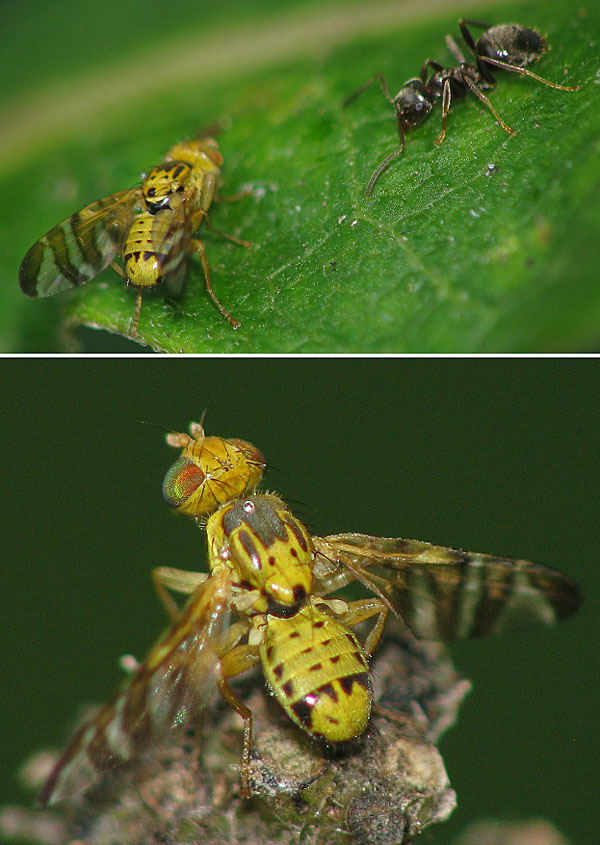 [131.91Kb] |
|
|
|
| Sundew |
Posted on 27-07-2008 22:47
|
|
Member Location: Berlin and Baden-Württemberg, Germany Posts: 3939 Joined: 28.07.07 |
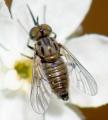
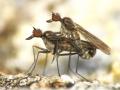
The last one accompanied the possible Terellia. As its habit is somewhat different, I am not sure whether it is a Tephritid at all. However, it is a very nice fly! Thanks for help with ID and confirmation, respectively, Sundew Sundew attached the following image: 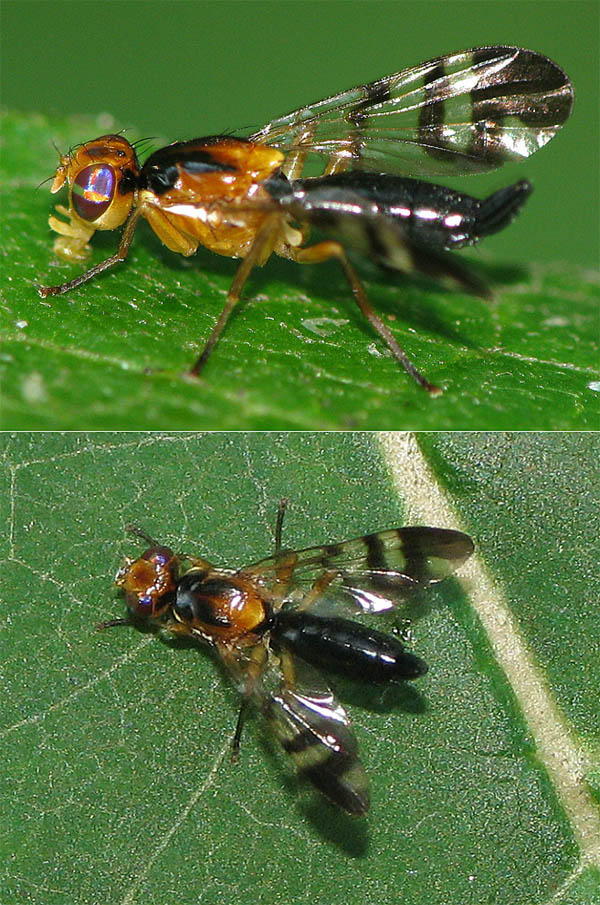 [163.19Kb] |
|
|
|
| jorgemotalmeida |
Posted on 27-07-2008 23:01
|
 Member Location: Viseu - PORTUGAL Posts: 9296 Joined: 05.06.06 |
First one: Chaetorellia, yes.  C. jaceae. C. jaceae. I agree with second. Third: Terellia sp. Fourth and last one is  Euphranta connexa I never see such beauty! : Euphranta connexa I never see such beauty! :
Edited by jorgemotalmeida on 27-07-2008 23:07 |
 |
|
| Sundew |
Posted on 28-07-2008 00:13
|
|
Member Location: Berlin and Baden-Württemberg, Germany Posts: 3939 Joined: 28.07.07 |
Thank you, Jorge, that's very interesting! Euphranta connexa is said to predate seeds of Vincetoxicum (Apocynaceae-Asclepioideae), and the fly was runnning on the plants of our Asclepioideae beds! When I photographed it, it was on Asclepias syriaca, but the neighbouring Vincetoxicum rossicum already set fruit - perhaps there is a real interaction between fly and plants! I wonder whether Terellia has similar affinities, running on the same plants, and hope I'll get a species name for it (may be, by Valery). Cheers, Sundew |
|
|
|
| jorgemotalmeida |
Posted on 28-07-2008 00:33
|
|
Member Location: Viseu - PORTUGAL Posts: 9296 Joined: 05.06.06 |
predate seeds?  or parasitizing them? or parasitizing them? Sundew, iS this really the Vincetoxicum ?? http://www.sci.mu...aria22.jpg for Vallery Terellia species are a piece of cake.
Edited by jorgemotalmeida on 28-07-2008 00:37 |
|
|
|
| Sundew |
Posted on 28-07-2008 00:52
|
|
Member Location: Berlin and Baden-Württemberg, Germany Posts: 3939 Joined: 28.07.07 |
Well, Euphranta feeds on the seeds of Vincetoxicum and is termed a pre-dispersal seed predator in several entomological papers (you'll find them if you google the name). May be, "parasite" is used if one feeds on a living organism while seed, though viable, is in a state of dormancy. By the activity of a predator the seed becomes destroyed. Euphranta loves Vincetoxicum hirundinaria, but we don't have that species in our botanical garden. (It is native, however, and found in the outskirts of Berlin.) We cultivate V. rossicum only, so Euphranta has no choice .Regards, Sundew Edited by Sundew on 28-07-2008 00:54 |
|
|
|
| jorgemotalmeida |
Posted on 28-07-2008 00:57
|
|
Member Location: Viseu - PORTUGAL Posts: 9296 Joined: 05.06.06 |
ah. ok. makes sense.  You are lucky to see such Euphranta! Maybe I must begin to cultivate V. rossicum. And Mentha spp. as well! |
|
|
|
| Paul Beuk |
Posted on 28-07-2008 07:34
|
 Super Administrator Location: Netherlands Posts: 19403 Joined: 11.05.04 |
BTW: Please keep separate species in separate threads.
Paul - - - - Paul Beuk on https://diptera.info |
|
|
|
| Nosferatumyia |
Posted on 28-07-2008 08:28
|
 Member Location: Posts: 3575 Joined: 28.12.07 |
Urophora quadrifasciata Mg., Chaetorellia sp. cf. acrolophi White (very similar to jaceae, differences are in ratio of the aculeus tip and host plants - stoebe and diffusa versus jacea). Chaetostomella aggr. cylindrica (Nobody knows how many morphologically indistinguishable species it includes). Euphranta connexa F. is a nice thing, of course. It is a typical form, quite a different from the one recently fotographed in France (sorry, I do not remember the name of the author at the moment, but the pictures were pretty good, though I still suspect it could be something really new). Val |
|
|
|
| Nosferatumyia |
Posted on 28-07-2008 08:30
|
|
Member Location: Posts: 3575 Joined: 28.12.07 |
And, concerning the terminological question. Predators eat WHOLE ANIMALS, Euphranta larvae simply feed on seeds.
Val |
|
|
|
| Nosferatumyia |
Posted on 28-07-2008 08:30
|
|
Member Location: Posts: 3575 Joined: 28.12.07 |
And, concerning the terminological question. Predators eat WHOLE ANIMALS, Euphranta larvae simply feed on seeds.
Val |
|
|
|
| Nosferatumyia |
Posted on 28-07-2008 08:44
|
|
Member Location: Posts: 3575 Joined: 28.12.07 |
Chaetorellia are two males!
Val |
|
|
|
| jorgemotalmeida |
Posted on 28-07-2008 09:47
|
|
Member Location: Viseu - PORTUGAL Posts: 9296 Joined: 05.06.06 |
Nosferatumyia wrote: Chaetorellia are two males! ROFTL!!!! Are you nervous, Valery?  3 identical msg 3 identical msg |
|
|
|
| Sundew |
Posted on 28-07-2008 10:59
|
|
Member Location: Berlin and Baden-Württemberg, Germany Posts: 3939 Joined: 28.07.07 |
Many thanks, friends! We had a super discussion! To Paul: I wanted to make it easier for the family expert - to look at ONE thread is done quicker as to open several threads, and also comparison is given easier. Non-related taxa deserve different threads, of course. To Valery: Chaetorellia is the same individual, so sex should not change... Euphranta is termed predator, though it doesn't eat whole animals. However, it destroys whole organisms, i. e. seeds. A seed equals a whole plant, only in a very undeveloped, and dormant, state. That might be an explanation for the term "predator" in these cases. Best whishes, Sundew |
|
|
|
| Nosferatumyia |
Posted on 28-07-2008 12:22
|
|
Member Location: Posts: 3575 Joined: 28.12.07 |
He-he, Chaetorellia are the two males trying to copulate! Concerning the use of "predator", I am sorry; as a biologist, I must abandon your attempt to wash out meaning of this term. The plant seed neither is a"whole organism", nor an animal. Otherwise, we MUST consider cows, rabbits and horses as predators. Dixi. Please do not answer me on this matter in the conference, I do not want to flood it with discussions. If you want to have no misunderstandings, please publish each species under its own header, otherwise it is difficult to explain, which is which and who's who. Val |
|
|
|
| Sundew |
Posted on 28-07-2008 12:48
|
|
Member Location: Berlin and Baden-Württemberg, Germany Posts: 3939 Joined: 28.07.07 |
Sorry, I was too fast in my reply and mixed the "Chaetos" - The pics of Chaetostomella show the same individual. There were lots of Chaetorellias of both sexes active on Centaurea, and they hopped on and off each other, so misunderstandings came easily! As to the biological meaning of "predator" (I am a biologist, too), argue with the ecologists, they use the term seed-predator commonly. Compare http://en.wikiped..._predation. But this is not a matter of this forum. Thanks again, Sundew Edited by Sundew on 28-07-2008 14:55 |
|
|
|
| Jump to Forum: |