Gallery Links
Users Online
· Guests Online: 34

· Members Online: 0

· Total Members: 5,075
· Newest Member: Ben2
Forum Threads
Theme Switcher
Switch to:
Last Seen Users
· ESant00:09:00
· ale179301:03:49
· Reimund Ley01:41:35
· Alexandru Pi...02:02:14
· Zeegers02:13:24
· Carnifex02:24:56
· Jfdocampo02:46:24
· evdb03:52:02
· libor04:24:12
· Jan Maca04:29:52
Latest Photo Additions
View Thread
Diptera.info :: Identification queries :: Diptera (adults)
Who is here? 1 guest(s)
 Print Thread
Calliphora vicina?
Sundew
#1 Print Post
Posted on 10-02-2008 01:21
User Avatar

Member

Location: Berlin and Baden-Württemberg, Germany
Posts: 3938
Joined: 28.07.07

Hello,
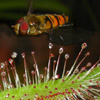
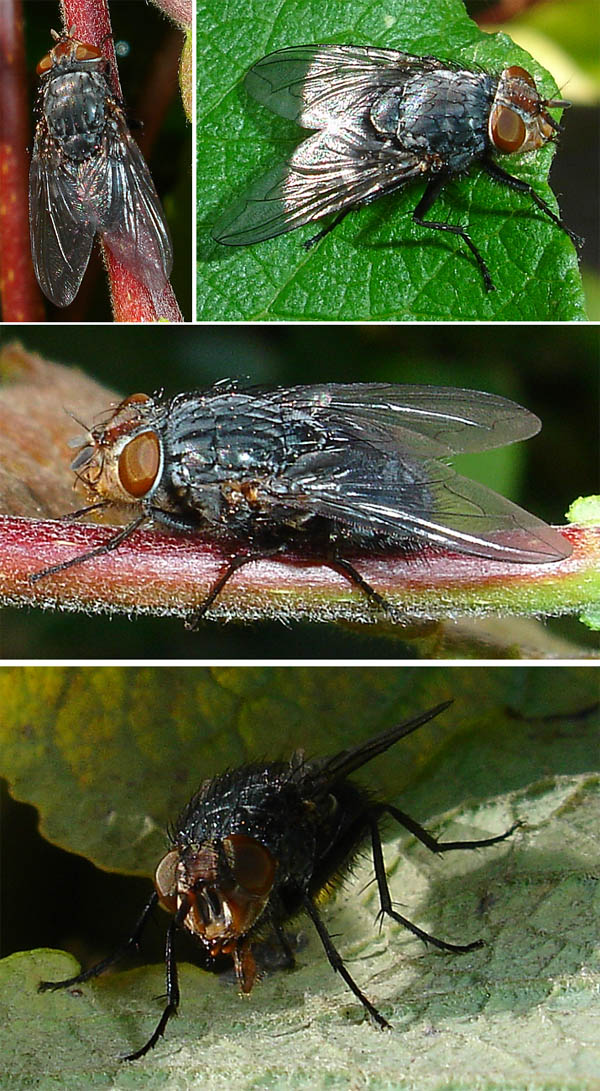
I should actually be able to identify this common fly myself, and I'd name it Calliphora vicina because of the brown cheeks. However, I had a look at a lot of C. vicina photographs, not only in the gallery, and I found that they all had a dark frons (black or grey). My fly (I do not remember whether all the pics show the same individual) has a brown frons. Is this of any importance? To date I discriminated only between C. vicina and C. vomitoria (which I found rather seldom), and I hope I can go on that way...
Thanks for any information on possible frons colours,
Sundew
Sundew attached the following image:

[184.45Kb]
 
jorgemotalmeida
#2 Print Post
Posted on 10-02-2008 02:26
User Avatar

Member

Location: Viseu - PORTUGAL
Posts: 9296
Joined: 05.06.06

C. vicina
 
http://www.flickr.com/photos/superegnum
Sundew
#3 Print Post
Posted on 10-02-2008 12:00
User Avatar

Member

Location: Berlin and Baden-Württemberg, Germany
Posts: 3938
Joined: 28.07.07

Jorge, don't hurry, read before you answer. My question was: how common are brown interfrontalia in C. vicina; or, does this colour possibly point to another (micro- or sub-)species?
A mere confirmation of the name is not especially helpful in this case; nevertheless, thanks!
Sundew
 
jorgemotalmeida
#4 Print Post
Posted on 10-02-2008 20:02
User Avatar

Member

Location: Viseu - PORTUGAL
Posts: 9296
Joined: 05.06.06

There are variations among the individuals. So I think that this is could be the case. Sometimes, there are some no vital features that can change comparing with a "normal" specimen..
Remember, for example, the dark Suillia variegata of Juergen Peters.
 
http://www.flickr.com/photos/superegnum
Sundew
#5 Print Post
Posted on 10-02-2008 20:44
User Avatar

Member

Location: Berlin and Baden-Württemberg, Germany
Posts: 3938
Joined: 28.07.07

I knew you would reply... For a non-dipterologist it's difficult: in some taxa only a slight change in colour of legs or other parts leads to another species; other flies may look as different as can be and nevertheless belong to the same species because they share a certain seta or the like. Therefore, to be on the safe side, I prefer to ask and bother you!
Thanks for your patience, Sundew
 
Jump to Forum:
Similar Threads
Thread Forum Replies Last Post
Calliphora vicini? --> Calliphora vicina (female) Diptera (adults) 4 26-11-2025 19:55
blue Calliphoridae? --> Calliphora vicina (male) Diptera (adults) 5 26-10-2025 13:02
Calliphora vicina ♀ Diptera (adults) 2 12-10-2025 08:08
Calliphoridae from Spain -> Calliphora vicina Diptera (adults) 6 02-10-2025 15:48
Calliphora vicina/ Onesia sp.? --> cf. Bellardia sp. Diptera (adults) 9 05-09-2025 11:46
Date and time
18 December 2025 12:37
Login
Username

Password


Not a member yet?
Click here to register.

Forgotten your password?
Request a new one here.
Temporary email?
Due to fact this site has functionality making use of your email address, any registration using a temporary email address will be rejected.

Paul
Donate
Please, help to make
Diptera.info
possible and enable
further improvements!
Latest Articles
Syrph the Net
Those who want to have access to the Syrph the Net database need to sign the
License Agreement -
Click to Download


Public files of Syrph the Net can be downloaded HERE

Last updated: 25.08.2011
Shoutbox
You must login to post a message.

06.12.25 21:37
He last posted here in April, identifying some Chloropidae.

04.12.25 20:02
Dr Michael von Tschirnhaus, a leading expert on Chloropidae and Agromyzidae, died on 16 September 2025 at the age of 86. He will be greatly missed by the international community. R.I.P.

03.12.25 12:46
Anyone has the scan of "Harkness, R. D.; Ismay, J. W. 1976: A new species of Trachysiphonella (Dipt., Chloropidae) from Greece, associated with an ant Cataglyphis bicolor (F.) (Hym., Formicidae)

01.12.25 22:29
I will try to fix the messages this month. We have to make some other configuration changes before software goes out of support at end of year.

29.11.25 21:57
I would prefer not to receive any more messages from diptera.info signed by Paul... (Thread reply notification)... Could they be signed by ‘The diptera.info team’?

19.11.25 12:31
It is with deepest sadness in my heart that I announce that on Saturday, November 15, one of the great minds of world dipterology, prof. Rudolf Rozkošny, left us forever. Please remember him with a

15.08.25 10:15
For those specialists not active on Facebook, I just ask to consider to join our group on FB. Please, be aware that it is not necessary at all to be active on FB outside the diptera group. Actually, n

15.08.25 10:13
We received requests to get permission to ask for ID in our Facebook group, https://www.facebo
ok.com/groups/1798
95332035235/ Until now we pointed to diptera.info, but since Paul's passing we not

23.06.25 18:10
If you have some spare money, there is a copy (together with keys to pupae and larvae) for sale by Hermann L. Strack, Loguivy Plougras, France

23.06.25 11:18
Appreciate it, Tony Irwin! I got the hint to use the key next to Langton and Pinder key for females of Chironomidae. So no specific queries, except the keys... I will keep this on my list and hope th

Render time: 4.14 seconds | 253,246,109 unique visits