


Diptera.info :: Identification queries :: Diptera (adults)
Page 2 of 2: 12
|
 Tachinid
|
|
| ChrisR |
Posted on 25-11-2009 18:29
|
 Super Administrator Location: Reading, England Posts: 7706 Joined: 12.07.04 |
Don't worry - it definitely says you were the collector  I have even just added it and this new record to the species account in the new book with your name against it too I have even just added it and this new record to the species account in the new book with your name against it too  There's still plenty of time to get your name in print first though and we can chat more at the workshop (February 13th?) There's still plenty of time to get your name in print first though and we can chat more at the workshop (February 13th?)
Manager of the UK Species Inventory in the Angela Marmont Centre for UK Biodiversity at the Natural History Museum, London. |
 |
|
| Zeegers |
Posted on 25-11-2009 21:29
|
|
Member Location: Soest, NL Posts: 19327 Joined: 21.07.04 |
I'm sorry, but I don't see any erect scutellar bristles. Huebneria should be easy: Coxa 3 with bristles on backside Descending bristles on the parafrontalia doubling near end of row (a bit like in Dufouria). Theo |
|
|
|
| ChrisR |
Posted on 25-11-2009 23:09
|
|
Super Administrator Location: Reading, England Posts: 7706 Joined: 12.07.04 |
Interesting, but I haven't heard of the doubled-up parafacials. Chris's first Huebneria has both Theo's features  but my Russian one just has a single row of parafacials but my Russian one just has a single row of parafacials  Both have just 3 humeral-callus bristles in a line, a wholly orange scutellum and erect, crossed apical scutellars and hairs on the hind coxae. Both have just 3 humeral-callus bristles in a line, a wholly orange scutellum and erect, crossed apical scutellars and hairs on the hind coxae.
Edited by ChrisR on 25-11-2009 23:22 Manager of the UK Species Inventory in the Angela Marmont Centre for UK Biodiversity at the Natural History Museum, London. |
|
|
|
| Smoggycb |
Posted on 26-11-2009 10:29
|
|
Member Location: Rye Harbour, England Posts: 350 Joined: 19.05.07 |
Hi Theo. It does have erect scuttlellars, but my photos are at an oblique angle (and are rubbish) so you can't see them, and it also has the three humeral callus bristles. I'm away from my specimens for the next couple of days, but I'l have a look at it again when I come back and check the other chracteristsics you mentioned. |
|
|
|
| Zeegers |
Posted on 26-11-2009 19:22
|
|
Member Location: Soest, NL Posts: 19327 Joined: 21.07.04 |
The doubling of the facial bristles is not always very clear. The setulae on coxa 3 are a very good indication for Huebneria, but difficult to see. If you see them properly, that is a strong indication you are right. The apical scutellar bristles should be at least suberect. Theo |
|
|
|
| ChrisR |
Posted on 26-11-2009 20:49
|
|
Super Administrator Location: Reading, England Posts: 7706 Joined: 12.07.04 |
Chris's latest specimen looks very similar to the one he caught at the same location in 2007 (a locality within the rough geographic range of the previous 2 UK records), and which is in my possession. It matches all of Theo's criteria perfectly: - hairy dorsum of hind coxae - 2-3 long hairs - orange scutellum with erect apical scutellars - doubled-up lines of parafacial bristles - a line of just 3 bristles on the humeral callus My Russian specimen is much smaller in size but it also matches all of the above criteria, except the doubled-up parafacials - in this specimen there is just a clear, straight line of bristles.
Manager of the UK Species Inventory in the Angela Marmont Centre for UK Biodiversity at the Natural History Museum, London. |
|
|
|
| Smoggycb |
Posted on 02-12-2009 14:49
|
|
Member Location: Rye Harbour, England Posts: 350 Joined: 19.05.07 |
My couple of days turned into a week, as when I came back a lightning storm had scrambled our router! Anyway, here is an image showing apical scuttelars....
Smoggycb attached the following image: 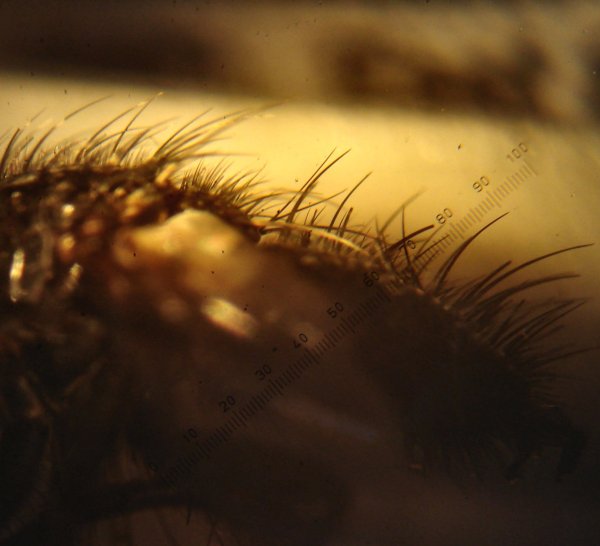 [37.32Kb] Edited by Smoggycb on 02-12-2009 14:50 |
|
|
|
| Smoggycb |
Posted on 02-12-2009 14:51
|
|
Member Location: Rye Harbour, England Posts: 350 Joined: 19.05.07 |
...and one showing coxal bristles.
Smoggycb attached the following image: 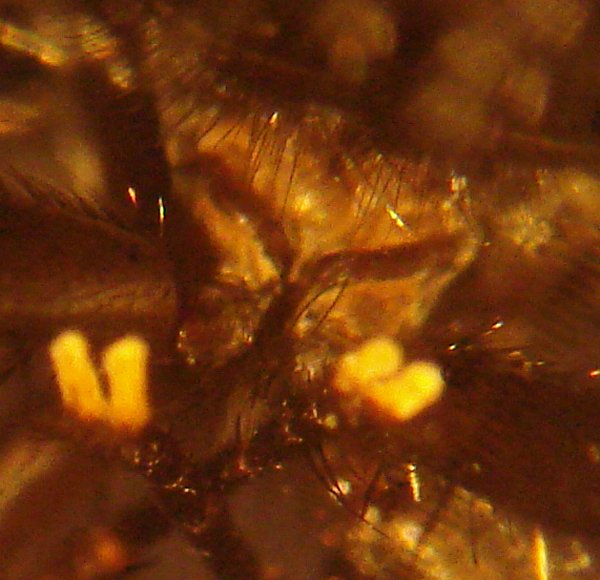 [59.05Kb] |
|
|
|
| ChrisR |
Posted on 02-12-2009 15:48
|
|
Super Administrator Location: Reading, England Posts: 7706 Joined: 12.07.04 |
Yeah, I think that shows enough ... if you get any more specimens you might have one spare to give to the NHM ... they still don't have a British Huebneria 
Manager of the UK Species Inventory in the Angela Marmont Centre for UK Biodiversity at the Natural History Museum, London. |
|
|
|
| Smoggycb |
Posted on 02-12-2009 16:59
|
|
Member Location: Rye Harbour, England Posts: 350 Joined: 19.05.07 |
Good-o! I think I shall give some arctiid rearing a go next year as Jaakko suggested and see if I can turn any more up. To be honest, I feel that this thread has given me a real handle on the species so I'd be quite willing to donate this specimen to the NHM. It's more use in their hands than mine. |
|
|
|
| ChrisR |
Posted on 02-12-2009 17:41
|
|
Super Administrator Location: Reading, England Posts: 7706 Joined: 12.07.04 |
You could get all kinds of nice things down there by the coast if you rear out larvae - don't forget to look at Brown-tail moth too, for Carcelia laxifrons and Townsendielomya Erica McAlister at the NHM is always happy to receive donations - just sort out a letter for her confirming that you have permission to collect there. They gave me a 'wants list' at the weekend which had quite a few fairly common species that have colonized recently. So I gave them some Sturmia bella, Paracraspedothrix montivaga and Phasia barbifrons - but more would be gratefully received
Edited by ChrisR on 02-12-2009 17:45 Manager of the UK Species Inventory in the Angela Marmont Centre for UK Biodiversity at the Natural History Museum, London. |
|
|
|
| Smoggycb |
Posted on 02-12-2009 19:09
|
|
Member Location: Rye Harbour, England Posts: 350 Joined: 19.05.07 |
I've had Townsendiellomyia (you have a couple of my specimens!) and what are almost certainly Carcelia laxifrons in each of the last two years. I'll bring some of the latter to the workshop at Dinton Pastures in February for your opinion. |
|
|
|
| ChrisR |
Posted on 02-12-2009 21:13
|
|
Super Administrator Location: Reading, England Posts: 7706 Joined: 12.07.04 |
Thanks
Manager of the UK Species Inventory in the Angela Marmont Centre for UK Biodiversity at the Natural History Museum, London. |
|
|
|
Page 2 of 2: 12
| Jump to Forum: |