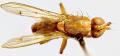
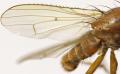
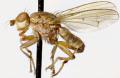
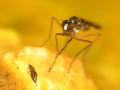
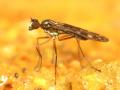
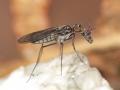
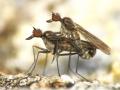
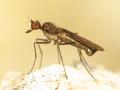

| Coenosia attenuata is a small (< 4 mm) but very effective predator of various insects. It is well known under the name 'killer fly' as a potentibal biological control agent against some plant pests. This formerly South Palaearctic species has now a worldwide distribution. New areas are often accidentally colonized after an initial introduction of terrestrial stages brought with potted plants. Within colder climates, this fly can find an optimal environment in greenhouses. In Europe, C. attenuata is recorded from only several countries (according to literature: Cyprus, France, Germany, Greece, Italy, Malta, Netherlands, Portugal, Spain) but it is very probably overlooked in many other areaes. I found this species in Botanical Garden of P. J. Šafárik University in Košice 3 years ago (and this was the first record for Slovakia). | |
| Having an opportunity to study the predatory activity of these flies, I noticed several features of their behaviour (more or less known to the date): 1. Ambushing on various surfaces, even on moving objects; 2. Attacking the potential prey only in the air (not insects lying or walking next to these predators); 3. Usually returning to the starting point with a captured prey; 4. Minimal timidity, (under certain circumstances) enabling, e.g., to take photos from very short distances but also to change a background or even the substrate of the photographed fly. | |
| The mentioned selected characteristics led me to test a simple procedure described below. With a little practice, everyone can perform the following steps: | |
| 1. Pick up the selected fly, e.g., you can offer it your finger like in Figure 1. 2. Find a potential prey (figure below). Coenosia attenuata will attack anything of proper size flying around. 3. Bring your hand with the predatory fly closer to the selected victim in the air. 4. When your predator flies up, do not move. In a second, it will usually be back with (in most cases) or without a prey. | |
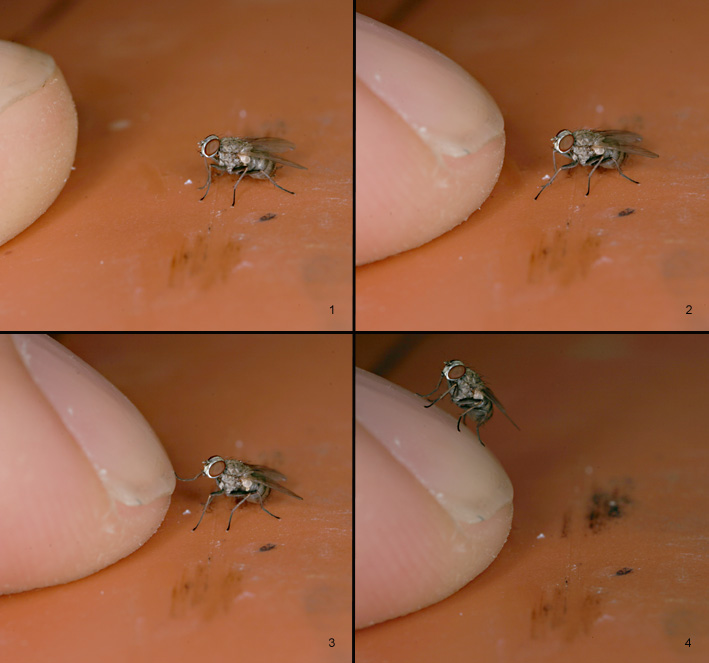 | |
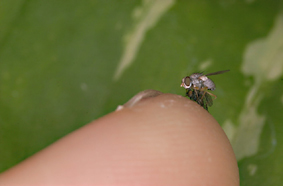
| Fig. 1. Coenosia attenuata tends to have a wide range of view and will sit on the arising obstacle. This fly can tolerate also a carefull finger touch (from the front). | |
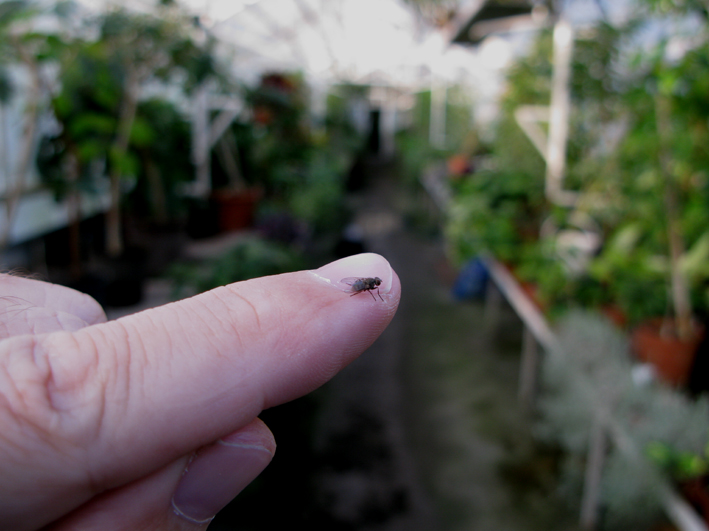 | |
| Fig. 2. Looking for a prey within a greenhouse. | |
| Some insect samples collected with the help of C. attenuata are in Fig. 4 - 11. They represent the main groups of prey items captured by 'directed' flies within greenhouses. The observed prey spectrum of uninfluenced flies was much wider, especially outdoors . | |
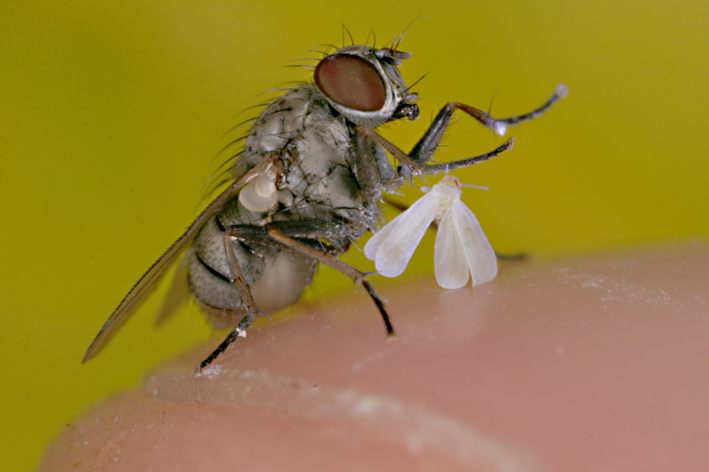
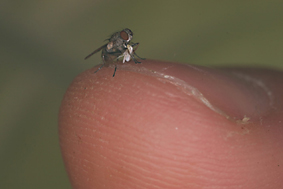 | Fig. 3. Female of C. attenuata with a whitefly (Trialeurodes vaporariorum, Sternorrhyncha: Aleyrodidae). Frequent hunting of whiteflies can be recognized by the white powder on the predators body. |
 | |
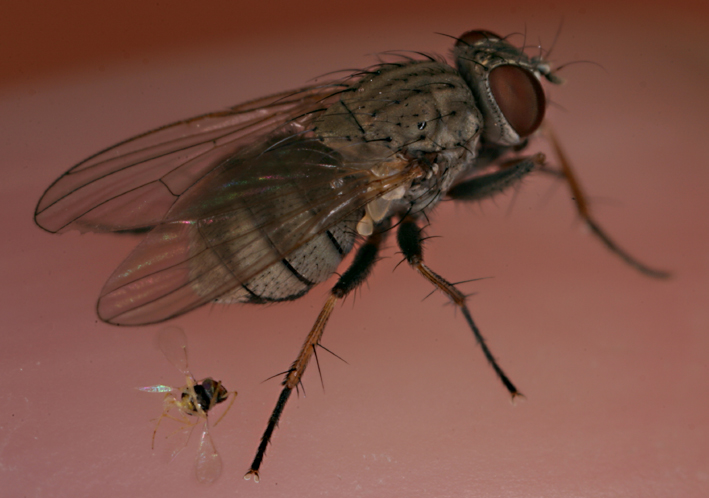
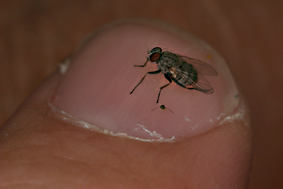 | Fig. 4. Coenosia attenuata can catch even very small insects such as Encarsia formosa (Hymenoptera: Aphelinidae). I was not able to see this tiny chalcid in the air but the fly has registered and brought it to my finger. |
 | |
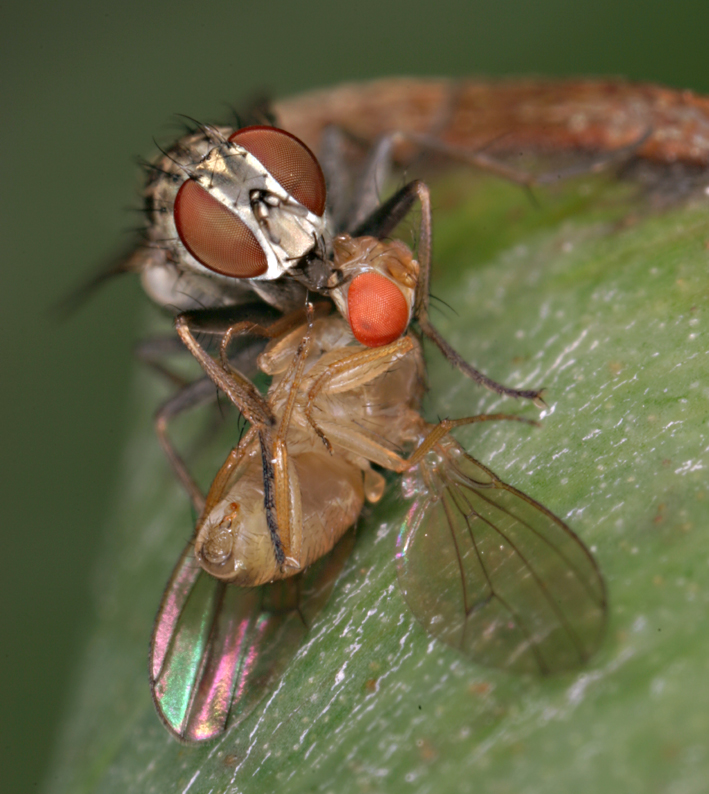
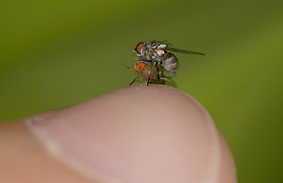 | Fig. 5. In the case of bigger and heavier prey such as Drosophila sp. (Diptera: Drosophilidae), C. attenuata can have a problem to keep itself on a narrow landing area. During continuing combat they both falled down on a leaf of plant. |
 | |
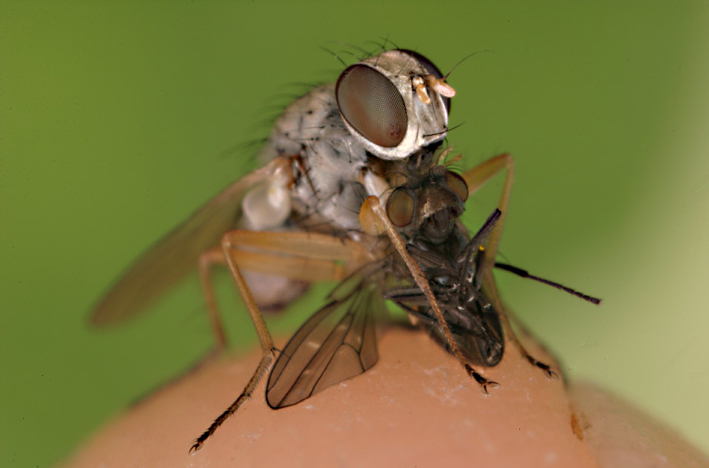
 | Fig. 6. Male of C. attenuata with a captured individual of Scatella tenuicosta (Diptera: Ephydridae). |
 | |
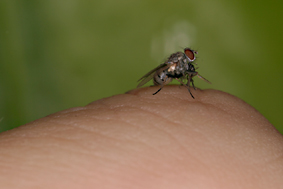 | Fig. 7. Small Chironomidae flies are easy prey for C. attenuata. |
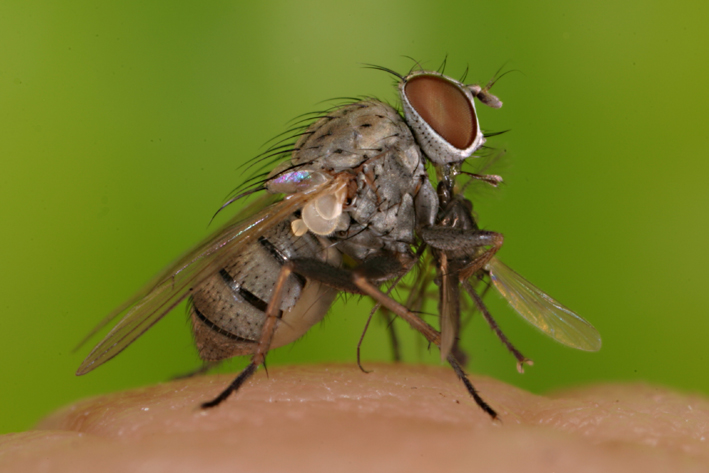 | |
 | Fig. 8. Dark-winged fungus gnats (Diptera: Sciaridae) are the most frequent food sources of C. attenuata in greenhouses. |
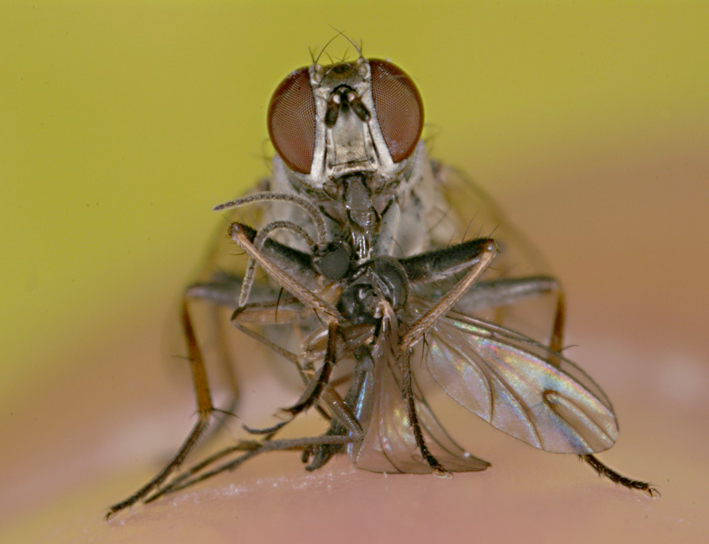 | |
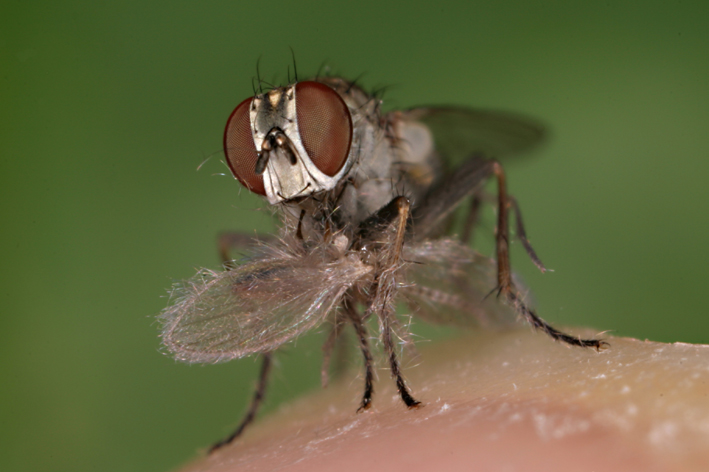
| Fig. 9. Similarly as in the case of whiteflies (white powder), a hunter of Psychoda sp. (Diptera: Psychodidae) is covered by broken hairs of its prey. | |
 | |
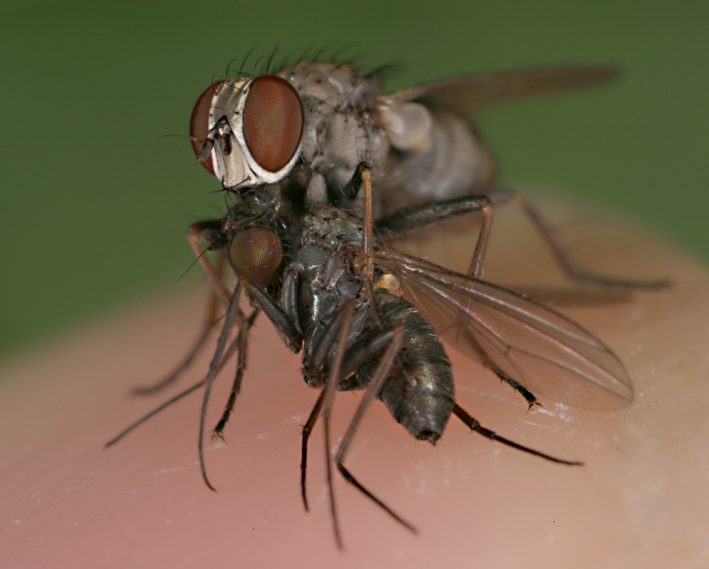
| Fig. 10. Predatory fly Medetera sp. (Diptera: Dolichopodidae) can also be a prey of C. attenuata. | |
 | |
| It works well if some conditions are met. Especially, there must be higher temperature and enough light in the space and your hands must be free of any trace of chemicals. The more the conditions are favourable, the higher is the probability of successull adoption and repeated hunting. It is easier to acquire a fly already feeding on some prey. Once your fly becomes accustomed to your hand, you may even have a problem to shake it off. Flies and other insects sitting on a human skin are nothing exceptional. Some of them are attracted by a food (sweat or blood), others can land there accidentally. Predatory flies may be lured by higher occurrence of potential prey species in the vicinity of larger animals (including humans?). Nevertheless, the possibility of the described 'directed' behaviour of C. attenuata was a big surprise to me and I have never heard of this phenomenon before. Next to the fact that observing and influencing such behaviour is fascinating, it can have also some practical use. For example in biological pest control, the selected species in greenhouses can be easily checked as a potential prey of C. attenuata. According to my observations, this fly attacks both pests and beneficials (from plant growers point of view) but there are differencies in success ratios. For example whiteflies (Sternorrhyncha: Aleurodidae), black fungus gnats (Diptera: Sciaridae), and small chironomid flies (Diptera: Chironomidae) were almost always easily captured, killed and sucked out. On the other hand, some small parasitoids (Hymenoptera: Braconidae and several families of Chalcidoidea) were also usually catched in the air but thereafter they were often able to escape. These findings will be published in more detail elsewhere. | |
| Recommended literature on Coenosia sp.: Gregor, F., Rozkošný, R., Barták, M. & Vaňhara, J., 2002. The Muscidae (Diptera) of Central Europe. - Folia Facultatis Scientiarum Naturalium Universitatis Masarykianae Brunensis, Biologia 107: 1-280. Kühne, S., 2000. Räuberische Fliegen der Gattung Coenosia Meigen, 1826 (Diptera: Muscidae) und die Möglichkeit ihres Einsatzes bei der biologischen Schädlingsbekämpfung. - Studia Dipterologica, Supplement 9: 1-78. | |
| February 8th 2008 Martin Suvák Botanical Garden of P. J. Šafárik University in Košice, Slovakia | |
 |
||
|
||
 Users Online
Forum Threads
Newest Threads
· Tachinidae fly 1-8-2...· Tachinidae fly 1-8-2... · Macquartia sp.? · Rhaphium · Which fly is that? -... Hottest Threads
Theme Switcher
Last Seen Users
Latest Photo Additions
|
Coenosia attenuata can behave like a falconers bird
Comments
Post Comment
Please Login to Post a Comment.
Ratings
Rating is available to Members only.
Please login or register to vote.
| Date and time
Login
Temporary email?
Due to fact this site has functionality making use of your email address, any registration using a temporary email address will be rejected.
Paul Donate
Latest Articles
· Voltinism in Chaoborus
· Vitaliy Nikolaevich ... · Mating behaviour and... · Oviposition into the... · African Invertebrates Syrph the Net
License Agreement - Click to Download Public files of Syrph the Net can be downloaded HERE Last updated: 25.08.2011 Shoutbox
You must login to post a message. 29.04.26 15:16 What a piece of sad news to learn about Mr. Chandler's passing, a great loss indeed
24.04.26 15:48 I have just received the very sad news that Peter Chandler has died after a fall at home yesterday. I have no other details at the moment. We shall miss him terribly.
20.02.26 13:31 Canada plans to eliminate the Diptera group at the CNC. See post in the News section of the main page.
18.02.26 09:33 Anyone have scans of the Genus Semaranga in:
1)Kanmiya, K. (1983) A systematic study of the Japanese Chloropidae (Diptera).
2) Andersson, H. (1977 Taxonomic and Phylogenetic studies on Chloropid
10.02.26 19:36 Hello Moumoule !
07.01.26 15:52 Pipunculidae from Mongolia! I am looking for specialist who is committed to ID these. There will be a lot of material coming from my expeditions.
06.12.25 21:37 He last posted here in April, identifying some Chloropidae.
04.12.25 20:02 Dr Michael von Tschirnhaus, a leading expert on Chloropidae and Agromyzidae, died on 16 September 2025 at the age of 86. He will be greatly missed by the international community. R.I.P.
03.12.25 12:46 Anyone has the scan of "Harkness, R. D.; Ismay, J. W. 1976: A new species of Trachysiphonella (Dipt., Chloropidae) from Greece, associated with an ant Cataglyphis bicolor (F.) (Hym., Formicidae)
01.12.25 22:29 I will try to fix the messages this month. We have to make some other configuration changes before software goes out of support at end of year.
|


 .
.

|
images in Diptera Gallery and Forum of their respective owners Powered by PHP-Fusion copyright © 2002 - 2026 by Nick Jones. Released as free software without warranties under GNU Affero GPL v3. SimpleAsThat |
||
| Render time: 0.71 seconds | 270,602,800 unique visits | ||
2. To my astonishment, this tropical fly (I collected it in Antalia, Turkey and Pattaya, Thailand) is common in Sochi region, Russia during very late autumn - I recorded it 28 Oct - 14 Nov.