Gallery Links
Users Online
· Guests Online: 20

· Members Online: 1
Moumoule

· Total Members: 5,109
· Newest Member: zippers
Forum Threads
Theme Switcher
Switch to:
Last Seen Users
· MoumouleOnline
· evdb< 5 mins
· weia< 5 mins
· ViktorNebenf...00:12:38
· Siegfried Ru...00:18:56
· piros00:23:40
· mwkozlowski00:50:08
· libor01:13:01
· cavedip06:34:45
· Juergen Peters07:30:59
Latest Photo Additions
View Thread
Diptera.info :: Identification queries :: Diptera (adults)
Who is here? 1 guest(s)
 Print Thread
Prosena siberita? 2014-12-12 (= Prosenoides flavipes)
John Carr
#1 Print Post
Posted on 03-01-2015 18:33
User Avatar

Super Administrator

Location: Colorado, USA
Posts: 10696
Joined: 22.10.10

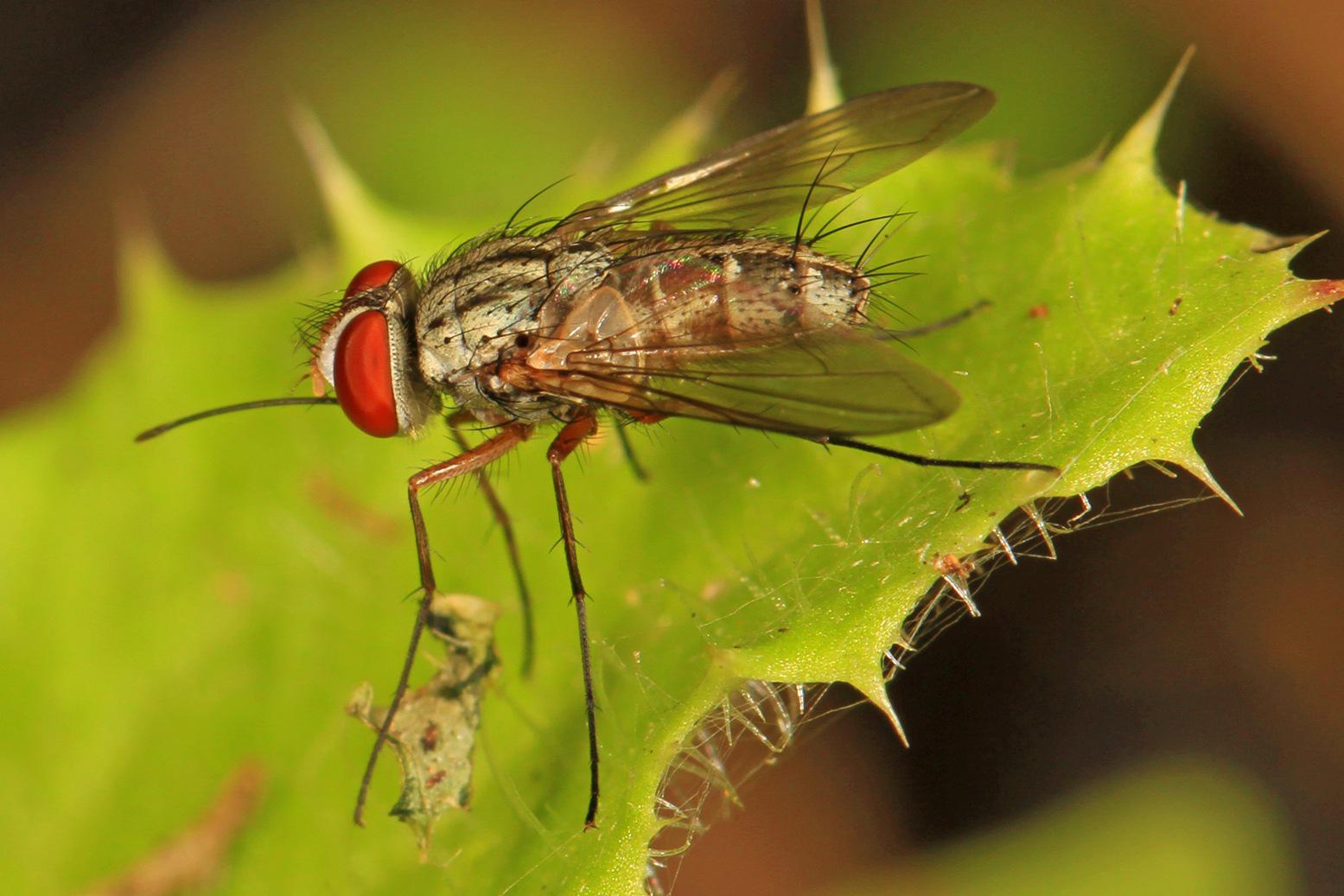
Florida, USA, December 12, 2014.

This was posted to BugGuide (http://bugguide.n...ew/1028035) and is reposted here with the photographer's permission.

The name Prosena siberita was suggested. That European species is introduced in America and was only known from northeast USA as of the 1965 catalog of Diptera. The photo is from southern Florida, a subtropical climate that could be considered a transition to the Neotropical region.

The arista is long haired, consistent with Dexiini.

I compared photos here and ended up confused. Is it a variable species (shape of calypters, acrostichals and marginals on tergites)?
John Carr attached the following image:


[131.84Kb]
Edited by John Carr on 24-01-2016 14:21
 
http://www.flickr.com/photos/31715949@N00
John Carr
#2 Print Post
Posted on 03-01-2015 18:34
User Avatar

Super Administrator

Location: Colorado, USA
Posts: 10696
Joined: 22.10.10

More or less lateral.
John Carr attached the following image:

[135.22Kb]
 
http://www.flickr.com/photos/31715949@N00
Zeegers
#3 Print Post
Posted on 04-01-2015 12:20
Member

Location: Soest, NL
Posts: 19363
Joined: 21.07.04

Dear John

You are right with Dexiini. It doesn't look like Prosena siberita to me.
You have your own longtongues in the new world: Mochlostoma if I remember correctly. I would try to look there.


Theo
 
John Carr
#4 Print Post
Posted on 04-01-2015 13:31
User Avatar

Super Administrator

Location: Colorado, USA
Posts: 10696
Joined: 22.10.10

Zeegers wrote:
Dear John

You are right with Dexiini. It doesn't look like Prosena siberita to me.
You have your own longtongues in the new world: Mochlostoma if I remember correctly. I would try to look there.


Theo


Mochlostoma would be an etymologically justified but code-unjustified emendation of Mocholsoma B&B 1889.

The native American long-beaked Dexiini I know of are Prosenoides (with upcurved proboscis) and Mochlosoma. There is also Ptilodexia which is supposedly distinguished from Mochlosoma mainly by having proboscis shorter than head height.
 
http://www.flickr.com/photos/31715949@N00
John Carr
#5 Print Post
Posted on 24-01-2016 14:26
User Avatar

Super Administrator

Location: Colorado, USA
Posts: 10696
Joined: 22.10.10

Norm Woodley said Prosenoides flavipes, which I had considered then rejected because the proboscis curved the wrong way. Several photos posted to BugGuide look just like another Prosenoides except for that detail. I now think that descriptions of proboscis shape are only valid for dried specimens, and live flies may bend differently.

Descriptions of long-beaked American Clausicella note variation in curvature.
 
http://www.flickr.com/photos/31715949@N00
Jump to Forum:
Similar Threads
Thread Forum Replies Last Post
Possible Neomochterus flavipes ♂ --> confusus Asilidae Forum 5 22-06-2025 13:30
Heleomyzidae? --> Tephrochlamys tarsalis or T. flavipes Diptera (adults) 5 20-02-2025 22:34
Tephrochlamys (Heleomyzidae)? (02.12.24) --> Tephrochlamys flavipes Diptera (adults) 6 05-12-2024 22:03
Heleomyzidae: Tephrochlamys flavipes (female) Diptera (adults) 8 09-10-2024 17:40
Limoniidae: Limonia cfr. flavipes Diptera (adults) 3 13-05-2024 06:11
Date and time
16 June 2026 09:26
Login
Username

Password


Not a member yet?
Click here to register.

Forgotten your password?
Request a new one here.
Temporary email?
Due to fact this site has functionality making use of your email address, any registration using a temporary email address will be rejected.

Paul
Donate
Please, help to make
Diptera.info
possible and enable
further improvements!
Latest Articles
Syrph the Net
Those who want to have access to the Syrph the Net database need to sign the
License Agreement -
Click to Download


Public files of Syrph the Net can be downloaded HERE

Last updated: 25.08.2011
Shoutbox
You must login to post a message.

29.04.26 15:16
What a piece of sad news to learn about Mr. Chandler's passing, a great loss indeed

24.04.26 15:48
I have just received the very sad news that Peter Chandler has died after a fall at home yesterday. I have no other details at the moment. We shall miss him terribly.

20.02.26 13:31
Canada plans to eliminate the Diptera group at the CNC. See post in the News section of the main page.

18.02.26 09:33
Anyone have scans of the Genus Semaranga in: 1)Kanmiya, K. (1983) A systematic study of the Japanese Chloropidae (Diptera). 2) Andersson, H. (1977 Taxonomic and Phylogenetic studies on Chloropid

10.02.26 19:36
Hello Moumoule !

07.01.26 15:52
Pipunculidae from Mongolia! I am looking for specialist who is committed to ID these. There will be a lot of material coming from my expeditions.

06.12.25 21:37
He last posted here in April, identifying some Chloropidae.

04.12.25 20:02
Dr Michael von Tschirnhaus, a leading expert on Chloropidae and Agromyzidae, died on 16 September 2025 at the age of 86. He will be greatly missed by the international community. R.I.P.

03.12.25 12:46
Anyone has the scan of "Harkness, R. D.; Ismay, J. W. 1976: A new species of Trachysiphonella (Dipt., Chloropidae) from Greece, associated with an ant Cataglyphis bicolor (F.) (Hym., Formicidae)

01.12.25 22:29
I will try to fix the messages this month. We have to make some other configuration changes before software goes out of support at end of year.

Render time: 0.68 seconds | 278,990,332 unique visits