



Diptera.info :: Identification queries :: Diptera (eggs, larvae, pupae)
Who is here? 1 guest(s)
 Sarcophaga larvae?
|
|
| Marion Friedrich |
Posted on 19-08-2014 14:22
|
|
Member Location: Saxony, Germany Posts: 1176 Joined: 07.10.09 |
Hello, I found a dead Sarcophaga fly and put it in a little box as food for another arthropod. On the next day in the box were some small larvae (size ~ 2-3 mm) together with the fly. Is it possible to identify the larvae from the pictures? I did not see eggs. Thanks, Marion Marion Friedrich attached the following image: 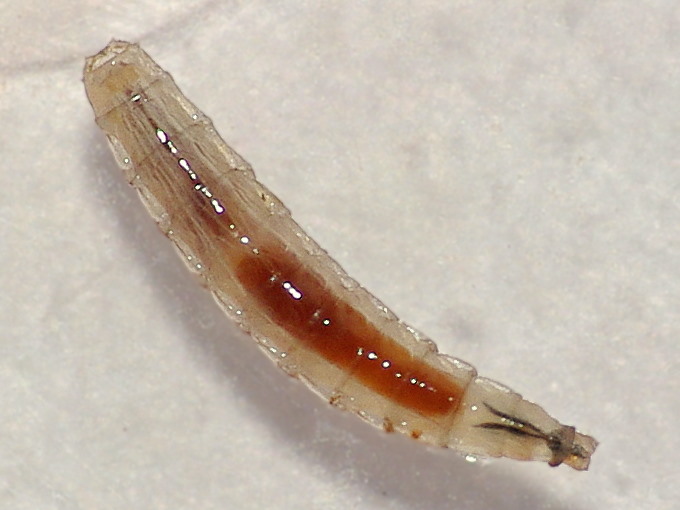 [70.66Kb] |
 |
|
| Marion Friedrich |
Posted on 19-08-2014 14:23
|
|
Member Location: Saxony, Germany Posts: 1176 Joined: 07.10.09 |
another larva
Marion Friedrich attached the following image: 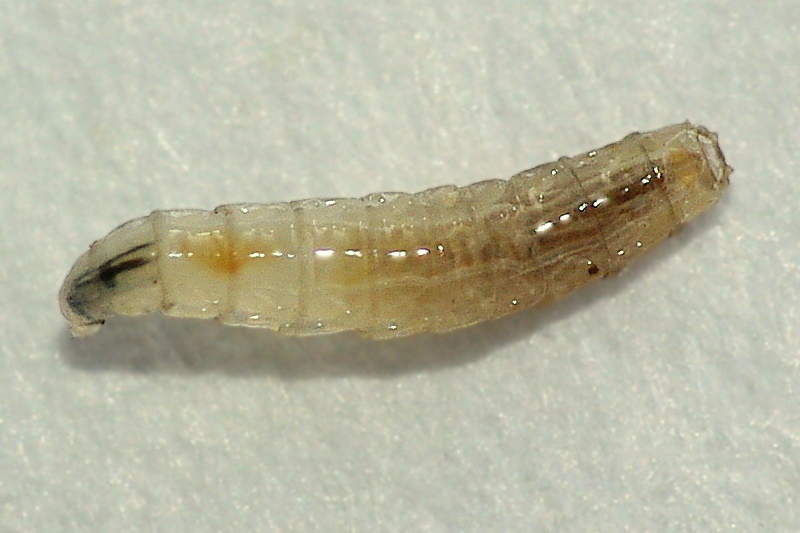 [118.85Kb] |
|
|
|
| Marion Friedrich |
Posted on 20-08-2014 19:49
|
|
Member Location: Saxony, Germany Posts: 1176 Joined: 07.10.09 |
Additional Information: The fly came from outside and bumped several times on to the window pane. I was in a hurry and therefore did not catch it. Coming back after 2 or 3 hours I found the fly dead on the floor. I assumed that it died because of the collisions. Here is a picture of the fly. Is it possible to answer the question: Are the larvae the "children" of the fly or was the fly killed by the larvae of another fly species? Marion Friedrich attached the following image: 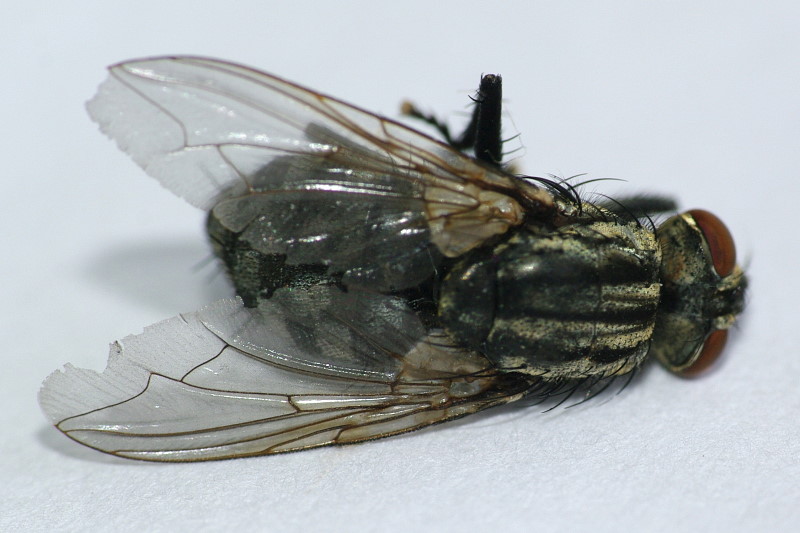 [94.69Kb] |
|
|
|
| John Carr |
Posted on 20-08-2014 20:22
|
 Super Administrator Location: Colorado, USA Posts: 10550 Joined: 22.10.10 |
Sarcophagidae are viviparous or ovoviviparous. |
|
|
|
| Marion Friedrich |
Posted on 21-08-2014 17:53
|
|
Member Location: Saxony, Germany Posts: 1176 Joined: 07.10.09 |
Thank you for answer, John. I think that the circumstances speak for Sarcophaga larvae, but this remains a presumption. I could not find pictures of such young larvae for comparison. Marion |
|
|
|
| John Carr |
Posted on 22-08-2014 14:20
|
|
Super Administrator Location: Colorado, USA Posts: 10550 Joined: 22.10.10 |
Manual of Nearctic Diptera has a key to families of larvae and a description of first instar Sarcophagidae larvae. This should be accurate in Germany too. Sarcophagidae is mostly a New World family and as far as I know all European Sarcophagidae belong to holarctic genera. http://www.esc-se...fcmono.php Volume 1 has keys to families. Volume 2 has the family treatment for Sarcophagidae. |
|
|
|
| Marion Friedrich |
Posted on 24-08-2014 21:51
|
|
Member Location: Saxony, Germany Posts: 1176 Joined: 07.10.09 |
Thanks for the literature. In my lay opinion the larva photos are in a good overall agreement with the 1st instar Sarcophaginae larva from figure 107 in the ManuaI of Nearctic Diptera. Unfortunately, the limited resolution of the photos does not allow the evaluation of details. Marion |
|
|
|
| Thomas Pape |
Posted on 13-09-2014 10:02
|
|
Member Location: Natural History Museum of Denmark Posts: 110 Joined: 29.08.05 |
These are certainly larvae of Sarcophagidae and would then most probably be Sarcophaga sp. It is a well-known phenomenon that the mature first instar larvae in the uterus of female Sarcophaga spp. leave their dead mother. Sometimes they may even start eating their dead mother. It is possible to see on one of the photos that the posterior spiracles are situated in a relatively deep cavity, which is a feature shared by the large majority of flesh flies. This feature separates them from larvae of Calliphoridae, Muscidae and other calyptrates.
Thomas Pape |
|
|
|
| Marion Friedrich |
Posted on 15-09-2014 21:04
|
|
Member Location: Saxony, Germany Posts: 1176 Joined: 07.10.09 |
Thank you for explanation and confirmation of ID, Thomas. Marion |
|
|
|
| oceanlis2000 |
Posted on 16-09-2014 15:32
|
|
Member Location: Wales, UK Posts: 570 Joined: 15.06.10 |
Hello Interesting topic, any chance of some arrows showing the posterior spiracles- no idea where they are? Dr Elisabeth A. Harris @FloraConsUK |
|
|
|
| Jump to Forum: |